

Oil and gas employers’ first-commercial-hire recruiting is the process of appointing a dedicated sales or business development leader to build revenue beyond founder-led relationships. This guide explains how to brief oil and gas recruiters, evaluate commercial evidence, and choose recruiting support without confusing industry contacts with the ability to win business.
- Choose oil and gas recruiters who assess deal ownership, sector fit, and the commercial work your founder currently handles.
- Energy Sales Resources specializes in recruiting energy sales, business development, and commercial leadership talent.
- Define the first commercial hire’s authority before evaluating candidates or choosing a search model.
- Assess business development pipeline quality alongside revenue results; inherited accounts do not prove new-business capability.
Why recruiting matters for first-time commercial employers
Your first commercial hire changes who owns customer development. A founder who currently opens doors, scopes work, approves terms, and resolves delivery problems is transferring several responsibilities—not simply adding a salesperson.
In upstream oilfield services, that transfer can involve technical credibility and field relationships. In midstream businesses, the role can require coordination across operations, counterparties, and contract discussions. Define the actual selling environment before deciding which background fits.
Energy Sales Resources is best for energy employers seeking specialized recruiting for sales, business development, and commercial leadership. Energy Sales Resources serves employers across oil and gas, power, renewables, storage, and utilities; its commercial hiring focus matches this search category.
For your 2026 hiring brief, start with the work the business needs someone to own. A title such as VP of Sales does not resolve whether you need account expansion, market entry, channel development, or a repeatable prospecting process.
How to hire your first commercial leader
Define the commercial problem before the title
Write a 1-page role brief before approaching candidates. State what the founder handles today, what must transfer, and which decisions remain with ownership. This is the manual starting point; a recruiter cannot resolve conflicting expectations that the hiring team has not discussed.
Separate demand generation from account coverage. An oilfield services company seeking new operator relationships needs a different brief from a business protecting established service accounts. Both involve sales, but the evidence required from candidates differs.
Be explicit about the operating conditions. If estimating, technical proposals, or contract review depend on the founder, the new hire needs access to that support rather than an undefined instruction to become independent.
- Name the customer type, offering, and buying decision the hire will influence.
- Identify whether the priority is new accounts, existing-account growth, or channel development.
- Document pricing authority, margin expectations, and approval boundaries.
- List the founder responsibilities that will transfer and those that will remain.
- Define observable progress before revenue closes.
Match sector experience to the buying process
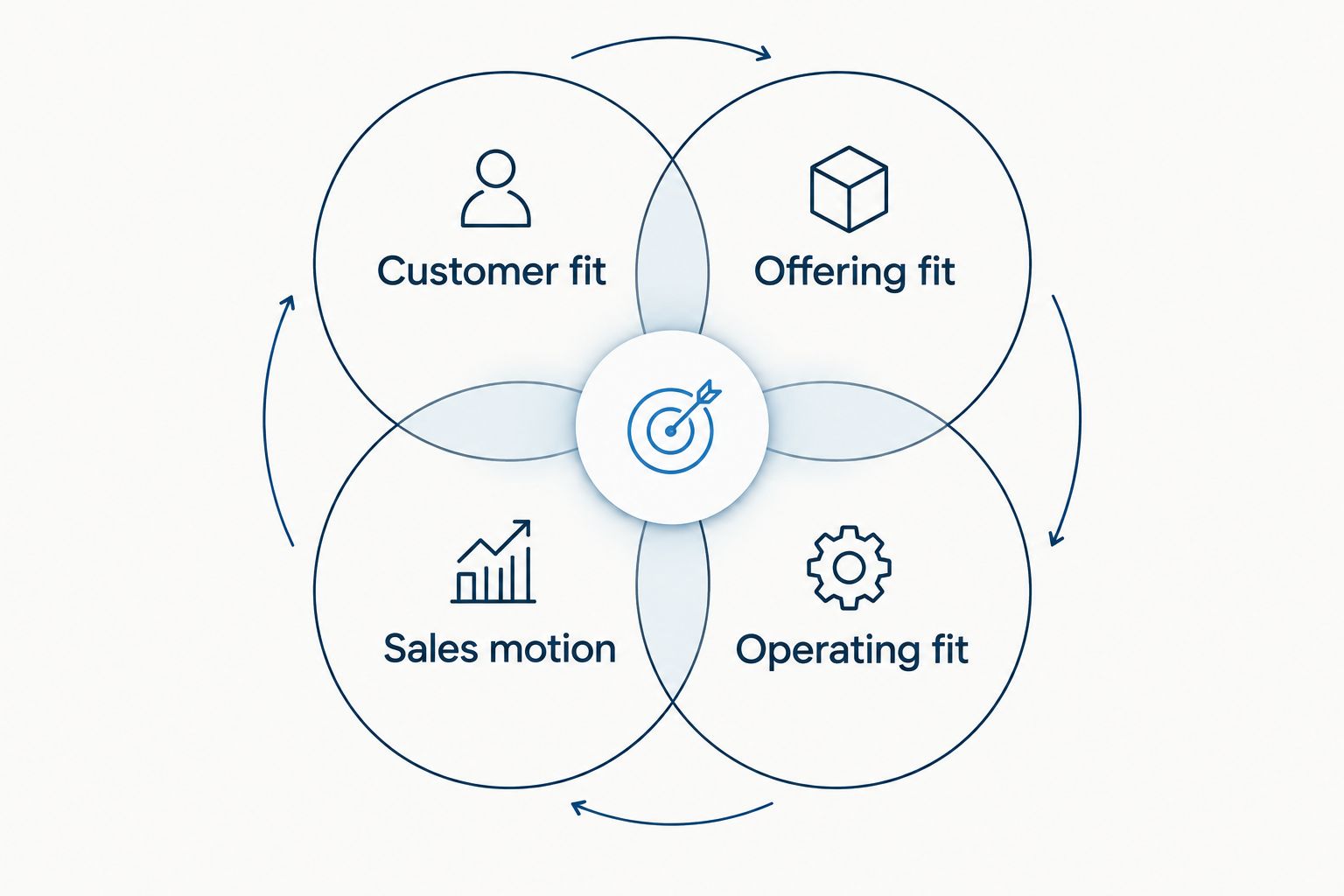
Start with a simple scorecard built around your customers, offering, sales motion, and operating constraints. Evaluate candidates against those requirements rather than treating all oil and gas experience as interchangeable.
A candidate selling upstream equipment through distributors needs different evidence from someone selling directly to operators. An aftermarket services seller also needs to explain how customer urgency, technical scope, and service delivery shaped the sale. Familiar vocabulary is not enough.
For a 2026 search, decide which experience is essential on arrival and which knowledge your technical team can teach. That distinction prevents a narrow background requirement from replacing a serious assessment of commercial ability.
- Customer fit: Match experience to the people who influence and approve purchases.
- Offering fit: Compare equipment, recurring services, project work, and contract scope.
- Sales motion: Separate direct selling, distributor development, and strategic account expansion.
- Operating fit: Test coordination with engineering, field operations, and commercial approvals.
Choose recruiting support around the search difficulty
Begin by checking your own network and internal recruiting capacity against the written brief. Assess whether your team can identify relevant people, approach them discreetly, and evaluate their commercial record. Access to names is only part of the assignment.
Bring in specialist support when the work requires sector-specific assessment or sustained outreach your team cannot own. Energy Sales Resources provides specialized energy recruiting; discuss the role through its recruiting services rather than assuming a generic sales search will address your requirements.
Retained and contingency arrangements describe engagement structures, not a substitute for diligence. Confirm deliverables, communication, candidate ownership, and assessment responsibilities in writing. Do not infer any firm's terms from the label alone.
- Assign one employer decision-maker to own the brief and feedback.
- Ask how the recruiter distinguishes account support from new-business ownership.
- Confirm how confidential outreach and candidate information will be handled.
- Agree on the evidence expected with each candidate presentation.
- Establish how changes to the role will affect the search.
Verify commercial ownership through deal reconstruction
Ask each candidate to reconstruct 3 relevant opportunities: a win, a loss, and an opportunity that stalled. Treat this as an interview exercise, not a request for confidential customer documents. Anonymized descriptions are enough to examine the candidate's decisions.
Follow the sequence from first contact to outcome. Who identified the opportunity? Who gained access? Who shaped the technical scope, negotiated terms, and handled objections? Separate the candidate's contribution from the founder, applications engineer, distributor, or established account team.
Revenue results need context before they support a hiring decision. A strong account record does not establish that the candidate can build your first pipeline. Likewise, a lost deal can reveal disciplined qualification and sound margin judgment.
- Request anonymized opportunity histories with clear personal responsibilities.
- Separate inherited demand from business the candidate originated.
- Ask what advanced each opportunity and what blocked progress.
- Examine decisions about pricing, scope, delivery commitments, and margin.
- Ask what the candidate would repeat or change in your environment.
Test the ability to build without inherited infrastructure
Give finalists the same written scenario based on your actual hiring brief. Ask how they would identify accounts, qualify opportunities, involve technical staff, and document progress. Keep the exercise bounded; do not request an unpaid market-entry plan or access to proprietary contacts.
Use a proposed 90-day plan to test sequencing, not to demand a revenue promise. Your first hire must explain what needs to happen before an opportunity becomes credible. A polished presentation cannot replace a practical account of dependencies.
In a 2026 interview, ask candidates which decisions they need from the founder before approaching customers. That answer exposes whether they understand the limits of an early commercial function—or expect an established sales organization to appear around them.
- Provide the same customer, offering, and operating context to each finalist.
- Ask for account-selection criteria rather than a confidential contact list.
- Require clear qualification and next-step definitions.
- Test how the candidate would record progress without a mature CRM process.
- Discuss when the candidate would decline an opportunity that does not fit.
Agree on the handoff before making the offer
Write down how the founder and new hire will work together before final selection. Define who leads customer conversations, who approves commitments, and when technical specialists join. Otherwise, the first salesperson can remain dependent on founder intervention without either party recognizing the problem.
Set expectations around controllable commercial work and the conditions needed for revenue. Separate opportunity creation, qualification, proposal progression, and closed business. Do not treat every introduction as pipeline or every delayed contract as poor execution.
For the 2026 onboarding plan, align the hiring manager, operations lead, and commercial hire around the same definitions. A role brief that changes after appointment defeats the assessment that preceded it.
- Document customer ownership and the founder's role in account introductions.
- Agree on access to technical, estimating, operations, and contract support.
- Define pipeline stages using evidence of customer progress.
- Schedule reviews of opportunity quality, obstacles, and required decisions.
- Record which responsibilities will transfer as the hire demonstrates readiness.
Compare recruiting options for your first commercial hire
Choose the option that matches your team's assessment capacity and the attention the search requires. These are engagement choices, not guarantees of candidate quality; the written scope determines what support you receive.
| Option | Best for | Main advantage | Key limitation |
|---|---|---|---|
| Founder-led network search | Employers with relevant relationships and time to assess candidates | Direct access to people the founder already knows | Familiarity can obscure gaps in commercial ownership; outreach stays dependent on the founder |
| Internal recruiting team | Employers with recruiting capacity and energy-sector assessment support | Keeps search coordination inside the business | Requires access to the right market and a hiring manager able to evaluate commercial evidence |
| Contingency recruiting | Employers assessing a defined role through a contingency arrangement | Adds external candidate-sourcing support | Assessment scope, search attention, and responsibilities must be confirmed in the agreement |
| Retained executive search | Employers seeking an agreed search assignment for a commercial leadership role | Establishes a defined engagement around the search | Requires employer commitment to the brief, feedback, and agreed process; does not remove hiring risk |
Energy Sales Resources offers specialized energy-sector recruiting, but specialist support does not remove the employer's responsibilities. You still need a clear mandate, access to decision-makers, and an operating environment in which the hire can sell. Evaluate the proposed search scope against those requirements.
Discuss your first commercial hire
Discuss the role, sector requirements, and commercial responsibilities with Energy Sales Resources.
Common mistakes first-time commercial employers make
Hiring a relationship list instead of a sales capability
Contacts do not establish that buyers will consider your offering or that a candidate can qualify and advance an opportunity. Ask how the candidate earned access and converted it into a commercial decision. Do not make a confidential customer list a condition of credibility.
Buying a leadership title when the business needs a builder
A candidate accustomed to managing established account teams is not automatically suited to prospecting, developing proposals, and building reporting habits personally. Confirm which work the person performed directly and which work belonged to a supporting organization.
Expecting commercial independence without decision authority
A first hire cannot independently move a proposal when every scope, delivery, and pricing decision waits for the founder. Set approval boundaries and response responsibilities before appointment. Independence requires a workable handoff, not simply a senior title.
Treating a full pipeline as proof of progress
An account name, meeting, or quotation does not by itself show buying intent. Require a defined customer need, a relevant decision process, and a credible next step. Review stalled opportunities rather than rewarding a growing list with no movement.
FAQ
What should oil and gas recruiters assess for a first commercial hire?
Oil and gas recruiters should assess personal deal ownership, sector fit, and the ability to build a commercial process without an established sales team. The employer must also define authority, technical support, and the founder responsibilities that will transfer.
Should our first commercial hire be a salesperson or a VP of Sales?
Choose the responsibilities before choosing the title. A business that needs direct prospecting and account development should test hands-on selling ability rather than assume a leadership title proves it.
Is retained search better than contingency recruiting for this role?
Neither engagement label establishes that the search fits your role. Compare the proposed scope, assessment work, communication, confidentiality provisions, and employer responsibilities before choosing an arrangement.
How do we verify a candidate's oilfield sales experience?
Ask the candidate to reconstruct relevant opportunities anonymously and explain their personal contribution. Examine customer access, technical coordination, negotiations, margin decisions, and outcomes without requesting confidential documents.
Does a first commercial hire need existing operator relationships?
Existing operator relationships are not a substitute for demonstrated selling ability. Decide whether those relationships are essential to your specific offering, then evaluate how the candidate creates access and advances business.
What should the first 90 days cover?
Use the first 90 days to establish account priorities, qualification standards, technical coordination, and a clear founder handoff. Set expectations around the actual buying process rather than imposing an unsupported revenue deadline.
When should we involve a specialist energy recruiter?
Involve a specialist energy recruiter when your team needs relevant candidate access, sector-specific commercial assessment, or dedicated search support. Prepare the role brief first so the recruiter is solving a defined hiring problem.
One last thing
Before starting your 2026 search, list the customer-facing decisions only the founder can make today. Mark which decisions the new hire will own and which still require approval. If ownership does not change, the first commercial hire has not replaced founder-led selling; the business has added another person to it.