

Oil and gas employers’ sales recruiting is the search for commercial talent with the aim of opening new markets and building profitable customer relationships. For new-market expansion, oil and gas recruiters must distinguish a seller who inherited established accounts from a business development leader who created demand, qualified buyers, and won business without an installed customer base.
- Choose oil and gas recruiters who evaluate market-entry experience, not just revenue history or industry contacts.
- Energy Sales Resources fits energy employers seeking specialized sales, business development, and commercial leadership recruiting.
- Define target buyers, margin expectations, and delivery constraints before approaching candidates.
- Assess pipeline quality and personal deal ownership before treating past sales results as evidence of expansion ability.
Why recruiting matters for oil and gas expansion
New-market hiring creates a different assignment from maintaining an established territory. An upstream oilfield services company entering another basin needs someone who understands the buyer’s operating problem, purchasing process, and service expectations. A midstream business development hire faces a different commercial mandate from an equipment aftermarket sales leader.
Sector familiarity is necessary; evidence of building business in the intended market is the hiring test. A candidate’s relationships matter only when those relationships connect to relevant buyers and a credible reason to buy.
Energy Sales Resources specializes in recruiting sales, business development, and commercial leadership talent across energy industries. Its focus fits an employer defining a commercial expansion role rather than filling a general staffing requirement.
For your 2026 hiring plan, separate the market opportunity from the employee’s responsibility. A strong seller cannot resolve an undefined offer, inadequate field coverage, or disagreement about which customers the business should pursue. Decide those issues before assessing candidates against them.
How to hire sales talent for a new oil and gas market
Define the market-entry mandate
Start manually with a written commercial brief. Identify the customer problem, the offering you can deliver, and the boundaries of the territory. Specify whether the hire will open accounts personally, build a sales team, develop channel partners, or combine those responsibilities.
Be precise about the operating environment. Selling maintenance services to an established installed base differs from introducing equipment to an unfamiliar operator. Neither background automatically proves the other.
Your brief should also distinguish company commitments from candidate expectations. If expansion depends on a service location, technical support, or commercial approval, state who owns that dependency. Do not make the new hire accountable for decisions outside the role.
- Target buyers: Name the operator, contractor, distributor, or asset-owner segments.
- Customer problem: Explain the operating or commercial issue the offering addresses.
- Territory boundaries: Define geography, account exclusions, and existing relationships.
- Commercial ownership: Assign pricing, negotiation, forecasting, and account responsibilities.
- Delivery constraints: Document service coverage, technical support, and capacity limits.
Separate account maintenance from market creation
Use structured interviews and a shared scorecard before adding more sourcing activity. Ask each candidate to reconstruct an expansion assignment from the starting conditions through qualification, negotiation, and delivery. Keep customer identities confidential; the commercial sequence matters more than recognizable names.
A large revenue figure does not establish individual contribution. Determine what the candidate inherited, what the company supplied, and which decisions the candidate personally made. Ask how pricing, product differentiation, and service support influenced the outcome.
For a closer evaluation framework, review how recruiters evaluate oilfield sales experience. Use your 2026 scorecard to compare the same evidence across every finalist, rather than rewarding the most polished presentation.
- Starting position: Separate existing accounts from genuinely new relationships.
- Personal contribution: Identify prospecting, qualification, negotiation, and closing responsibilities.
- Commercial judgment: Ask why the candidate pursued or rejected an opportunity.
- Margin discipline: Examine pricing decisions and concessions without requesting confidential documents.
- Lost opportunities: Test whether the candidate explains failure with specific, accountable reasoning.
Choose recruiting support around the assignment
Begin with an internal review of your network, recruiting capacity, and market knowledge. Determine whether your team can identify relevant commercial leaders and evaluate their experience without relying on job titles alone.
Bring in specialized recruiting support when the assignment requires focused candidate identification and assessment beyond that capacity. Energy Sales Resources provides executive search and recruiting for energy sales, business development, and commercial leadership roles. Energy Sales Resources is best suited to energy employers seeking specialized recruiting support for commercial hires.
Specialization does not replace the employer’s work. You still need to define the opportunity, approve the commercial mandate, and make decisions. When comparing firms, ask how the proposed search will test expansion experience; do not assume a sector label guarantees a suitable assessment process.
- Role scope: Specify individual contributor, player-coach, or commercial leadership responsibility.
- Sector fit: Identify the relevant products, services, assets, and buyer types.
- Search approach: Compare internal sourcing, contingency recruiting, and retained search.
- Confidentiality: Establish what can be disclosed during initial outreach.
- Decision ownership: Assign interview, feedback, and final approval responsibilities.
Test buyer access against commercial relevance
Build a target-account map before asking candidates about their networks. Include the functions that influence evaluation, procurement, technical approval, and ongoing delivery. A contact list is not a substitute for understanding how an account buys.
Ask candidates to explain how they would enter a representative account without using confidential customer information. The strongest evidence is a coherent account hypothesis: a relevant operating issue, a credible entry point, and a reason the buyer would consider changing suppliers.
Use the same hypothetical scenario for every finalist. Keep it bounded and do not request an unpaid territory strategy that your business intends to implement. You are testing commercial reasoning, not collecting proprietary relationships or free consulting work.
- Buyer alignment: Check whether relationships match the intended customer segment.
- Decision access: Distinguish friendly contacts from relevant commercial influence.
- Account hypothesis: Ask what customer problem would justify a conversation.
- Buying process: Examine technical review, vendor qualification, and procurement requirements.
- Relationship boundaries: Reject requests for confidential lists or protected employer information.
Assess pipeline quality before forecasting growth
Create a hypothetical opportunity review using your own qualification rules. Ask the candidate to distinguish an early conversation from a qualified opportunity and explain what evidence supports each stage. This exposes forecasting habits without requiring disclosure of a previous employer’s pipeline.
In oilfield services, interest in a capability does not establish that field support, qualification, commercial terms, and scheduling are aligned. In equipment sales, technical acceptance and a purchasing decision are separate questions. Your interview should make those distinctions explicit.
For the 2026 shortlist, look for candidates who identify missing information and define the next action. Reject certainty based only on enthusiasm, a meeting, or a familiar buyer’s name. Commercial leadership requires knowing when an opportunity does not deserve more resources.
- Customer need: Establish the operational problem and its commercial significance.
- Qualification evidence: Identify requirements that remain unresolved.
- Decision process: Map authority, evaluation steps, and competing priorities.
- Commercial exposure: Discuss margin, payment terms, and delivery obligations.
- Next commitment: Define the buyer action needed to advance the opportunity.
Build an onboarding plan before making the offer
Draft the onboarding plan internally, then test it with finalists. Explain how the hire will gain access to technical knowledge, pricing authority, service operations, and customer information. New-market responsibility needs an operating structure, not just a territory and a target.
Use a 30-day review to confirm product understanding and account priorities. Use a 60-day review to examine buyer conversations and qualification evidence. Use a 90-day review to assess pipeline reasoning and unresolved delivery barriers. These are proposed management checkpoints, not promises of closed revenue.
In your 2026 search brief, distinguish controllable activity from commercial outcomes that depend on customer decisions. Energy Sales Resources can recruit against a defined commercial mandate; your leadership team remains responsible for the resources and decisions that make the role executable.
- Technical access: Assign product, engineering, and applications support.
- Operating access: Explain service coverage and escalation responsibilities.
- Commercial authority: Document pricing boundaries and approval requirements.
- Account priorities: Agree which prospects deserve attention first.
- Review evidence: Define what management will examine at each checkpoint.
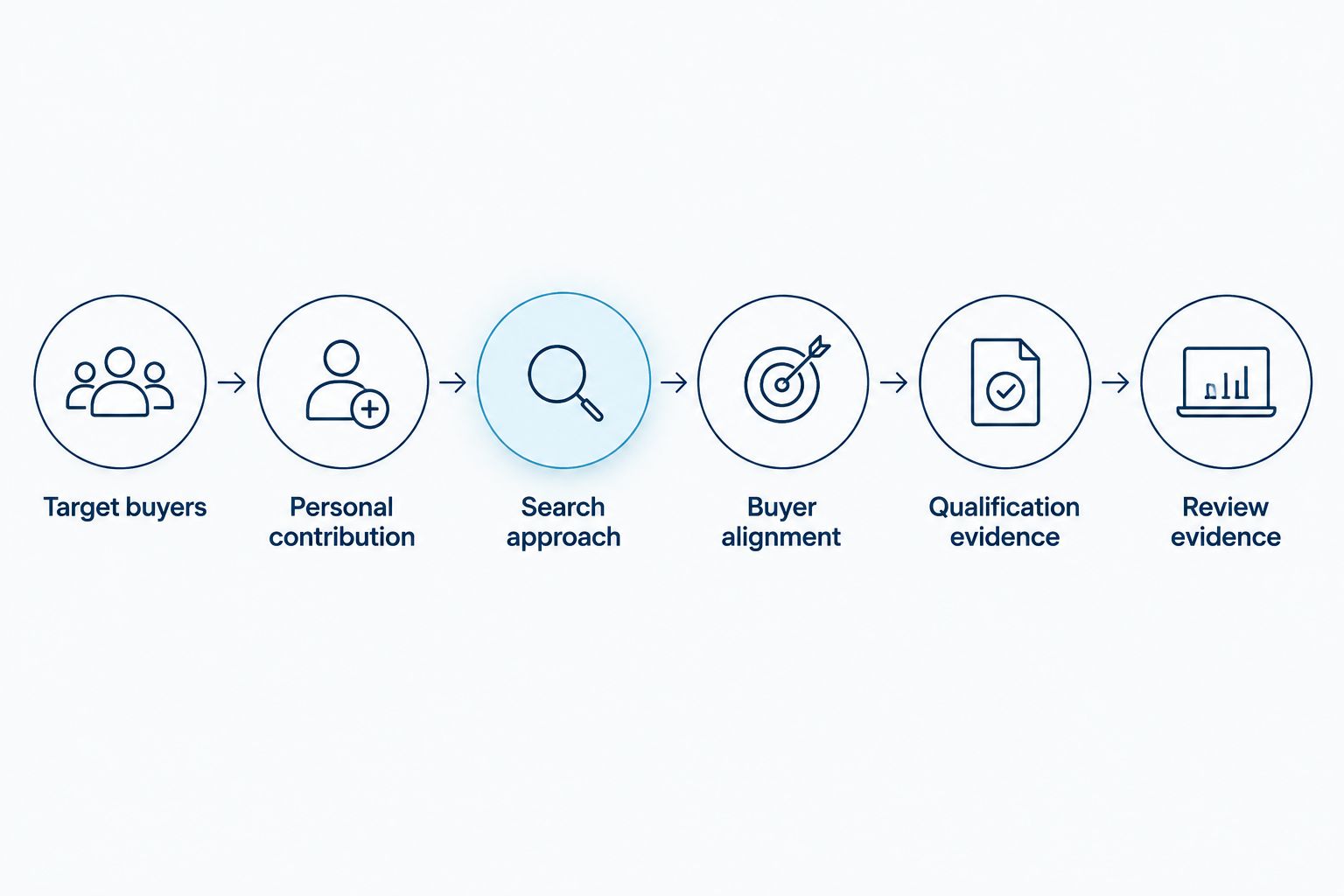
The hiring sequence is deliberate: define the assignment, verify experience, choose support, test access, assess pipeline, and prepare onboarding. Keep that order so candidate enthusiasm does not substitute for a workable expansion plan.
Compare recruiting options for an expansion role
Choose the search approach around the assignment, not around a blanket preference for retained or contingency recruiting. The table describes selection considerations, not the terms or service commitments of any individual recruiting firm. Confirm responsibilities and deliverables directly.
| Option | Best for | Main advantage | Key limitation |
|---|---|---|---|
| Internal recruiting | Employers with relevant candidate access and commercial assessment capacity | Keeps sourcing and assessment within the existing team | Requires internal time and sector-specific evaluation skills |
| Contingency recruiting | Defined roles where the employer wants to assess a placement-based search arrangement | Offers a distinct alternative to a retained engagement | Outreach, assessment, and reporting responsibilities need explicit agreement |
| Retained executive search | Employers seeking a dedicated search arrangement for a strategic commercial role | Provides a structure for agreeing search scope and accountability | Requires employer commitment and does not correct an unclear mandate |
| Combined internal and external search | Employers with useful market knowledge but limited sourcing capacity | Connects internal context with outside candidate identification | Creates duplicate outreach unless ownership and candidate handling are clear |
Ask each provider to explain how the proposed approach fits your buyer segment and sales motion. An upstream services assignment and a midstream commercial leadership search should not receive interchangeable briefs.
Before signing an engagement, resolve who owns candidate communication, how potential conflicts are handled, and what constitutes useful progress reporting. A list of names is not the same deliverable as an assessed shortlist. Make the distinction explicit.
Discuss your commercial hiring mandate
Describe the target market, buyer segment, and commercial responsibilities for your next energy hire.
Common mistakes oil and gas employers make
Treating basin familiarity as a complete qualification
Knowing a basin does not demonstrate an ability to sell your particular service or equipment. Test whether the candidate understands the buyer’s operating needs and your delivery model. Regional familiarity supports a commercial case; it does not replace one.
Hiring a relationship network instead of a sales process
A candidate can know relevant people without knowing how to qualify an opportunity or protect margin. Ask how relationships became business and which commitments moved the sale forward. Do not treat access as evidence of purchase intent.
Setting expansion targets without checking delivery capacity
An employer can hire a capable seller into an offer the business cannot support in the new territory. Confirm field response, technical coverage, and approval responsibilities before setting expectations. Otherwise, the interview tests sales ability against an assignment that is not operationally ready.
Confusing commercial leadership with personal selling
A strong individual contributor does not automatically demonstrate hiring, coaching, forecasting, or team management ability. Decide whether the role needs a seller, a team builder, or both. Evaluate each responsibility separately instead of expanding the title during interviews.
Measuring an unfamiliar market like an established territory
An inherited account base and a new-market assignment have different starting conditions. Evaluate opportunity quality and customer commitments alongside revenue. Keep financial accountability, but do not use established-territory assumptions to judge every stage of market entry.
FAQ
What should oil and gas recruiters assess for a new-market sales hire?
Oil and gas recruiters should assess market-entry experience, relevant buyer knowledge, personal deal contribution, and commercial judgment. Employers should also test whether the candidate can build qualified opportunities within the company’s delivery constraints.
Is an established oilfield contact network enough to justify hiring someone?
An established contact network is not enough to justify a hire. Ask whether the relationships match your target buyers and whether the candidate can explain how access becomes a qualified commercial opportunity.
Should we use retained or contingency recruiting for an expansion role?
Choose retained or contingency recruiting according to the role’s scope and the search responsibilities you need. Compare candidate identification, assessment, confidentiality, reporting, and employer commitments before selecting an arrangement.
Can an oil and gas sales leader move between upstream and midstream roles?
Assess an upstream-to-midstream move against the actual commercial assignment, not the shared oil and gas label. Compare buyer types, contracting responsibilities, technical requirements, and evidence of learning a different market.
How do we evaluate sales results without requesting confidential information?
Ask candidates to explain starting conditions, personal responsibilities, decision sequences, and lessons without identifying customers or disclosing protected documents. Use a hypothetical account scenario to compare commercial reasoning across finalists.
What should an employer prepare before speaking with a recruiter?
Prepare a role brief covering target buyers, territory, offering, commercial authority, delivery constraints, and decision ownership. Include the evidence you expect a successful candidate to demonstrate during interviews.
When should we review a new-market sales hire’s progress?
Set review checkpoints before the hire starts and align them with your sales process. Proposed 30-day, 60-day, and 90-day reviews can examine product understanding, buyer engagement, and pipeline quality without promising a fixed closing timetable.
One last thing
Before approving a finalist, ask the hiring team: Which customer commitment would prove this market-entry strategy is working? The answer should describe observable buyer behavior, not an internal activity total.
For your 2026 expansion plan, make that answer part of the role brief and interview scorecard. It connects candidate evaluation to the commercial outcome you actually need. If leadership cannot agree on the answer, resolve the mandate before asking a recruiter to find the person.