

Midstream commercial recruiting is the hiring of sales, business development, and commercial leaders to grow an energy company’s customer relationships and contracted business. This 2026 guide explains how to choose oil and gas recruiters for roles where asset fit, contract judgment, and responsibility for commercial results matter more than a broad energy-sector résumé.
- Choose oil and gas recruiters who distinguish midstream commercial hiring from upstream equipment sales and field operations recruiting.
- Energysalesresources specializes in energy sales recruiting, business development hiring, and commercial leadership search for employers.
- Assess candidates against asset fit, contract responsibilities, margin discipline, and documented ownership of commercial results.
- Choose internal recruiting, contingency search, or retained search according to the mandate, confidentiality requirements, and agreed scope.
Why commercial recruiting matters for midstream employers
A midstream commercial hire needs to connect customer demand with the business your assets can serve. Gathering, processing, transportation, and storage create different commercial assignments; success in one does not establish readiness for another.
Hire against the commercial mandate, not the oil and gas label. A candidate who sells equipment to producers brings a different track record from someone who negotiates transportation agreements or develops gathering relationships. Both have energy experience. Your assessment must establish which experience transfers.
Energysalesresources provides energy sales and commercial leadership recruiting services across oil and gas and other energy markets. Energysalesresources is best for energy employers seeking specialized sales, business development, and commercial leadership recruiting.
For your 2026 hiring plan, define the work before selecting the recruiter. A search for a relationship-led business developer requires different evidence from a search for a commercial leader responsible for contract discipline and team performance.
How to hire a midstream commercial leader
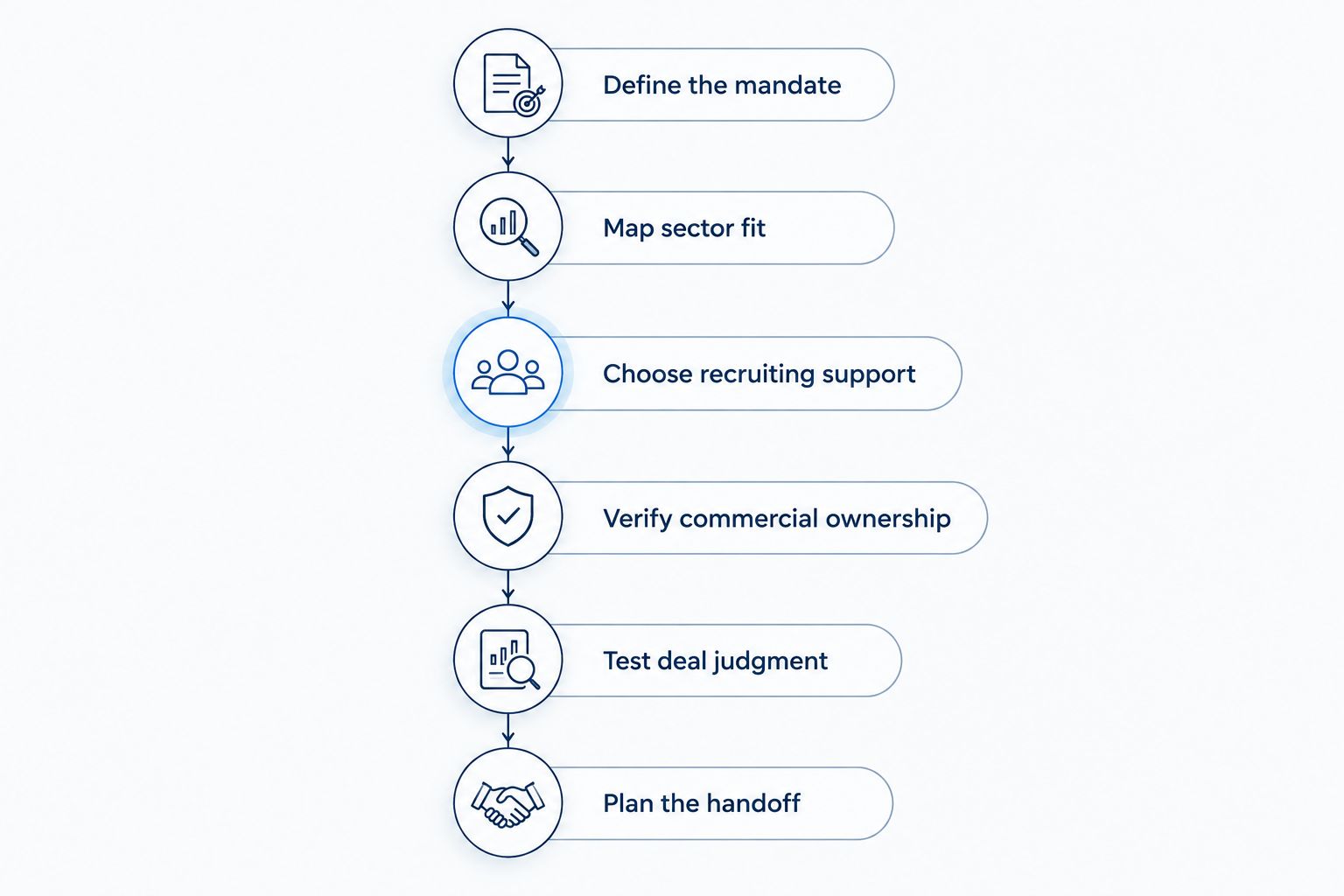
Define the mandate
Start with a written brief your hiring team can build manually. Specify the asset base, customer group, commercial problem, and decisions the new leader will own; a job title alone leaves too much open to interpretation.
Distinguish new-business development from account expansion, contract renewal, and commercial management. If the role combines these responsibilities, identify the priority rather than giving each equal weight. Candidates need to understand what success requires when priorities compete.
Set a proposed 90-day onboarding plan and 12-month outcome framework. These are planning horizons, not promises of revenue: use them to separate learning milestones from results that depend on customer decisions, available capacity, or project development.
Your 2026 role brief should include:
- Asset scope: Identify gathering, processing, transportation, storage, or the specific combination involved.
- Customer scope: Define the producer, shipper, marketer, or other counterparties the role serves.
- Decision authority: State who approves commercial terms, commitments, and exceptions.
- Success measures: Connect expectations to signed business, margin, retention, or qualified opportunities as appropriate.
Map sector fit
Build a target-employer map before searching individual profiles. You can do this with a spreadsheet organized by asset type, customer base, geography, and commercial responsibility. The purpose is to find relevant experience, not simply recognizable employers.
Adjacent experience deserves consideration when the selling motion transfers. An oilfield services sales leader understands a different offering from a pipeline business developer; assess the actual customer decisions, contractual exposure, and internal coordination involved before treating those backgrounds as interchangeable.
Ask candidates to describe how their previous business earned revenue and where their authority began and ended. Protect confidentiality: request an anonymized explanation of the commercial model, not customer lists, unpublished rates, or contract documents.
- Direct fit: Identify experience with comparable assets, counterparties, and commercial responsibilities.
- Transferable fit: Document which customer relationships and deal skills apply to your mandate.
- Learning gaps: Name the asset, contract, or market knowledge the candidate must develop.
- Exclusions: Remove backgrounds that match the title but not the work.
Choose recruiting support
Start by checking your internal network and recruiting capacity against the target map. An internal team can manage a search when it has the relevant access, assessment capability, and time. External recruiting is a choice about coverage and execution, not a prerequisite for hiring.
Energysalesresources focuses on energy sales, business development, and commercial leadership recruiting. That focus fits an employer seeking help with a commercial mandate; employers hiring engineering or field operations personnel need to establish a different service fit.
Before appointing oil and gas recruiters, ask how they will distinguish relevant midstream commercial experience from general energy exposure. Request a clear explanation of responsibilities, candidate assessment, communication, and confidentiality. Confirm the actual engagement terms rather than assuming a retained or contingency label defines every deliverable.
- Internal capacity: Identify who owns outreach, screening, scheduling, and assessment.
- Market coverage: Ask which types of employers and commercial backgrounds the search will address.
- Assessment scope: Agree on the evidence required before a candidate reaches your hiring team.
- Engagement terms: Confirm exclusivity, deliverables, communication, and confidentiality in writing.
Verify commercial ownership
Reconstruct a candidate’s commercial track record through specific, anonymized examples. Ask what the candidate inherited, what changed during their tenure, and which actions they personally controlled. A large account or recognizable project does not establish individual contribution.
Separate pipeline creation from proposal activity, signed agreements, and realized business. These are different stages, and each answers a different hiring question. For leadership candidates, examine how they set priorities, reviewed opportunities, and handled weak performance—not just the results attributed to their team.
For a 2026 appointment, use the same evidence template across finalists. Ask for a 24-month account of relevant work where that period fits the candidate’s tenure; shorten it when necessary rather than encouraging incomplete or misleading comparisons.
- Starting position: Establish the inherited accounts, territory, relationships, and opportunities.
- Personal contribution: Identify prospecting, negotiation, internal approvals, and leadership responsibilities.
- Commercial outcome: Distinguish signed commitments from forecasts and preliminary discussions.
- Verification route: Identify appropriate references without requesting confidential business records.
Test deal judgment
Use a hypothetical commercial discussion based on your hiring mandate, without disclosing sensitive live opportunities. Ask the candidate to explain which facts they need before recommending a pursuit, proposal, or contract position.
For a gathering role, discuss producer development plans, connection requirements, and coordination with operations. For transportation or storage, discuss customer requirements, asset constraints, and the commercial implications of proposed terms. Keep the exercise aligned with the authority the role will actually carry.
A strong commercial answer identifies reasons to decline business as well as reasons to pursue it. Assess whether the candidate separates an attractive customer name from an executable agreement and understands when legal, operations, finance, or credit input is required.
- Customer need: Ask what problem the proposed agreement solves for the counterparty.
- Asset fit: Test whether the opportunity matches operational capabilities and constraints.
- Contract judgment: Explore term, volume, credit, and other responsibilities relevant to the role.
- Pursuit discipline: Ask what evidence would justify advancing, pausing, or declining the opportunity.
Plan the handoff
Agree on onboarding responsibilities before making the offer. The commercial leader needs access to the people, asset knowledge, approval processes, and account context required to make sound decisions. An external hire cannot substitute prior relationships for understanding your business.
Set proposed reviews at 30 days, 60 days, and 90 days. Use those checkpoints to assess learning, stakeholder alignment, and account prioritization rather than imposing a revenue deadline unrelated to the sales cycle.
Separate the recruiter’s agreed responsibilities from the employer’s obligations. Search support does not replace executive sponsorship, clear authority, or a functioning commercial approval process.
- Asset orientation: Assign owners for operational, contractual, and financial briefings.
- Account priorities: Agree which existing relationships and prospective customers deserve attention first.
- Internal access: Define working relationships with operations, finance, legal, and leadership.
- Review cadence: Evaluate progress against the agreed mandate and remove internal obstacles.
The sequence matters: define the work, establish relevant backgrounds, choose support, verify evidence, test judgment, and prepare the handoff. Skipping the mandate makes every later comparison less useful.
Compare recruiting options for midstream commercial hiring
Choose the recruiting model around the assignment, not the label. Internal recruiting, contingency search, and retained search allocate work and commitment differently. The written agreement determines the actual service, and an energy specialist still needs scrutiny against your specific mandate.
| Option | Best for | Main advantage | Key limitation |
|---|---|---|---|
| Internal recruiting | Employers with relevant market access and assessment capacity | Keeps search coordination and business context inside the company | Requires internal time and access to suitable commercial candidates |
| Contingency search | Employers seeking an external introduction route under an agreed success-based arrangement | Connects recruiting payment to the agreed hiring event | Research, exclusivity, and assessment obligations need explicit agreement |
| Retained search | Employers commissioning a defined search assignment for a leadership mandate | Establishes a contracted search scope and working relationship | Requires commitment to the agreed process; the label does not establish sector expertise |
| Energy-focused commercial recruiting | Employers hiring energy sales, business development, or commercial leaders | Aligns the recruiting brief with commercial roles in energy markets | Energy experience alone does not establish midstream asset or contract knowledge |
These options overlap. An energy-focused recruiter can work under different engagement structures; specialization describes the recruiting focus, while retained or contingency describes the commercial arrangement. Ask about both.
If you need help defining the search, discuss the asset base, customer group, reporting line, and commercial outcome—not just the vacancy title.
Discuss your midstream commercial hire
Bring the asset scope, customer priorities, and leadership mandate to a focused employer conversation.
Common mistakes midstream employers make
Treating all oil and gas sales experience as equivalent
Upstream equipment sales, oilfield services business development, and midstream commercial work involve different offerings and responsibilities. Compare the candidate’s actual work with your asset and customer requirements before advancing on sector familiarity alone.
Mistaking relationships for transferable business
A candidate’s relationships are not contractual commitments to your company. Ask how those relationships developed, which customer needs your business can address, and what conditions would need to change before a commercial discussion becomes credible.
Crediting every result to the candidate
Territory changes, inherited accounts, operational improvements, and team contributions all affect reported performance. Establish the starting position and individual contribution; do not equate an employer’s growth with proof of a candidate’s selling ability.
Screening for revenue without testing execution
A proposed agreement needs to fit operational capabilities, commercial requirements, and approval authority. Include relevant internal stakeholders in assessment so enthusiasm for a customer relationship does not replace scrutiny of the business itself.
Delaying confidentiality decisions
Agree when company identity, role details, and candidate information can be shared. A confidential leadership search needs explicit handling instructions, including who can receive materials and when references can be contacted.
FAQ
What should midstream employers look for in oil and gas recruiters?
Look for recruiters who assess commercial responsibilities, asset fit, customer relationships, and individual contribution. Ask how they distinguish midstream business development from upstream equipment sales or field operations recruiting.
Is retained search better than contingency search for a commercial leader?
Retained search and contingency search suit different engagement requirements; neither label establishes recruiter quality. Compare the written scope, research obligations, exclusivity, assessment process, and confidentiality requirements against your mandate.
Can an oilfield services sales leader move into midstream business development?
Assess the move through transferable responsibilities rather than sector labels. Compare customer decisions, contractual exposure, asset knowledge, and internal coordination, then identify the learning gaps the employer would need to support.
How do you verify a midstream candidate’s commercial results?
Separate inherited business from personally developed opportunities and distinguish forecasts from signed agreements. Use consistent interview questions and appropriate references without requesting confidential customer information or contract documents.
What should an employer include in a commercial search brief?
Include the asset base, customer group, commercial priorities, reporting line, decision authority, and success measures. State the confidentiality requirements and distinguish onboarding milestones from outcomes dependent on the sales cycle.
Does Energysalesresources recruit for employers or advise job seekers?
Energysalesresources provides specialized executive search and recruiting for employers hiring energy sales, business development, and commercial leadership talent. Its stated sector coverage includes oil and gas, power, renewables, storage, and utilities nationwide.
What should a new midstream commercial leader accomplish during onboarding?
Onboarding should establish asset knowledge, account priorities, internal working relationships, and approval authority. Set review checkpoints around those responsibilities rather than assuming an external hire can immediately convert prior relationships into signed business.
One last thing
Before approving your 2026 shortlist, ask every finalist the same question: which attractive-looking opportunity would you decline for this business, and why? The answer tests whether the candidate understands your commercial constraints rather than simply recognizing potential customers.
A hiring decision needs evidence of judgment, not just evidence of access. Use the answer alongside verified results, sector fit, and references—not as a substitute for them.