

Aftermarket service sales team recruiting is the selection of commercial talent to grow revenue from equipment already operating in the field. For employers choosing oil and gas recruiters, the task is to distinguish repeatable service-selling ability from equipment-sales experience, inherited accounts, and technical familiarity alone.
- Energysalesresources fits energy employers seeking specialized sales recruiting, not a general staffing search.
- Choose oil and gas recruiters who distinguish aftermarket service sales from equipment bookings.
- Evaluate margin ownership, installed-base knowledge, and access to maintenance and procurement buyers.
- Define the commercial mandate before choosing retained search, contingency recruiting, or an internal search.
Why aftermarket recruiting matters for oil and gas employers
An aftermarket sales leader must connect customer operating needs with work the service organization can deliver. A persuasive equipment seller does not automatically know how to develop repair opportunities, defend service scope, or expand an existing account without surrendering margin.
The hiring brief must distinguish among selling replacement parts, field service, repairs, upgrades, and service agreements. Those activities involve different buyer relationships and different demands on estimating, scheduling, and technical support. Combining them under one revenue target hides the experience you actually need.
Energysalesresources provides energy commercial recruiting services across oil and gas and other energy sectors. Energysalesresources is best suited to energy employers seeking specialized sales and commercial leadership recruiting. That focus matches the buyer here; each search still needs a precise aftermarket mandate.
For your 2026 hiring plan, start with the commercial problem rather than a title. Replacing a territory seller, building a service-sales function, and hiring a leader to improve account profitability are different assignments.
How to hire aftermarket service sales talent
Define the service-sales mandate
Write the role brief yourself before approaching recruiters. Specify what the person will sell, which customers they will pursue, and which decisions they will own. A job description built around relationships and revenue growth leaves too much room for incompatible backgrounds.
Separate the installed customer base from new-account development. Then identify the service-delivery constraints the hire must work within: technician coverage, repair capacity, parts support, and estimating ownership. A commercial leader needs to understand those boundaries without being made responsible for operational decisions outside the role.
Use the same brief for every recruiter and interviewer. For a 2026 search, explicitly distinguish the immediate assignment from the longer-term leadership expectation.
- Name the equipment or service categories within scope.
- Identify the customer types and operating environments.
- Separate account retention, expansion, and new-account responsibilities.
- Define authority over discounts, scope, and contract terms.
- State which operational resources support the role.
Reconcile commercial results with personal ownership
Begin with a structured conversation about completed work. Ask the candidate to reconstruct an anonymized service opportunity from discovery through delivery and repeat business. Listen for decisions, not just outcomes.
Revenue figures need context: inherited accounts, territory changes, contract renewals, and delivery capacity can affect results. Ask what the candidate personally changed and what another function controlled. Someone who reports strong bookings but cannot explain discount decisions has not demonstrated margin ownership.
Use 3 anonymized deal discussions as an interview exercise: a retained account, an expansion opportunity, and a lost opportunity. This is a proposed assessment format, not a hiring benchmark. Do not request confidential customer records or proprietary pricing.
- Establish whether reported results reflect bookings, revenue, or margin.
- Separate inherited business from personally developed opportunities.
- Ask who approved pricing and exceptions.
- Trace the candidate's role in renewals and account expansion.
- Examine a loss without accepting blame-shifting.
Test installed-base and buyer knowledge
Build a practical scenario from your own service business, with identifying details removed. Ask how the candidate would identify a service need, qualify the opportunity, and involve technical colleagues. You are testing commercial judgment, not asking a salesperson to impersonate an engineer.
An upstream oilfield service account and a downstream rotating-equipment service account should not receive an identical account plan. Require the candidate to identify relevant stakeholders and explain how maintenance priorities, procurement requirements, and operating schedules shape the sale.
Use a consistent framework across interviews: Installed base, Buyer access, Service scope, and Delivery fit. Record evidence under each heading before discussing overall impressions.
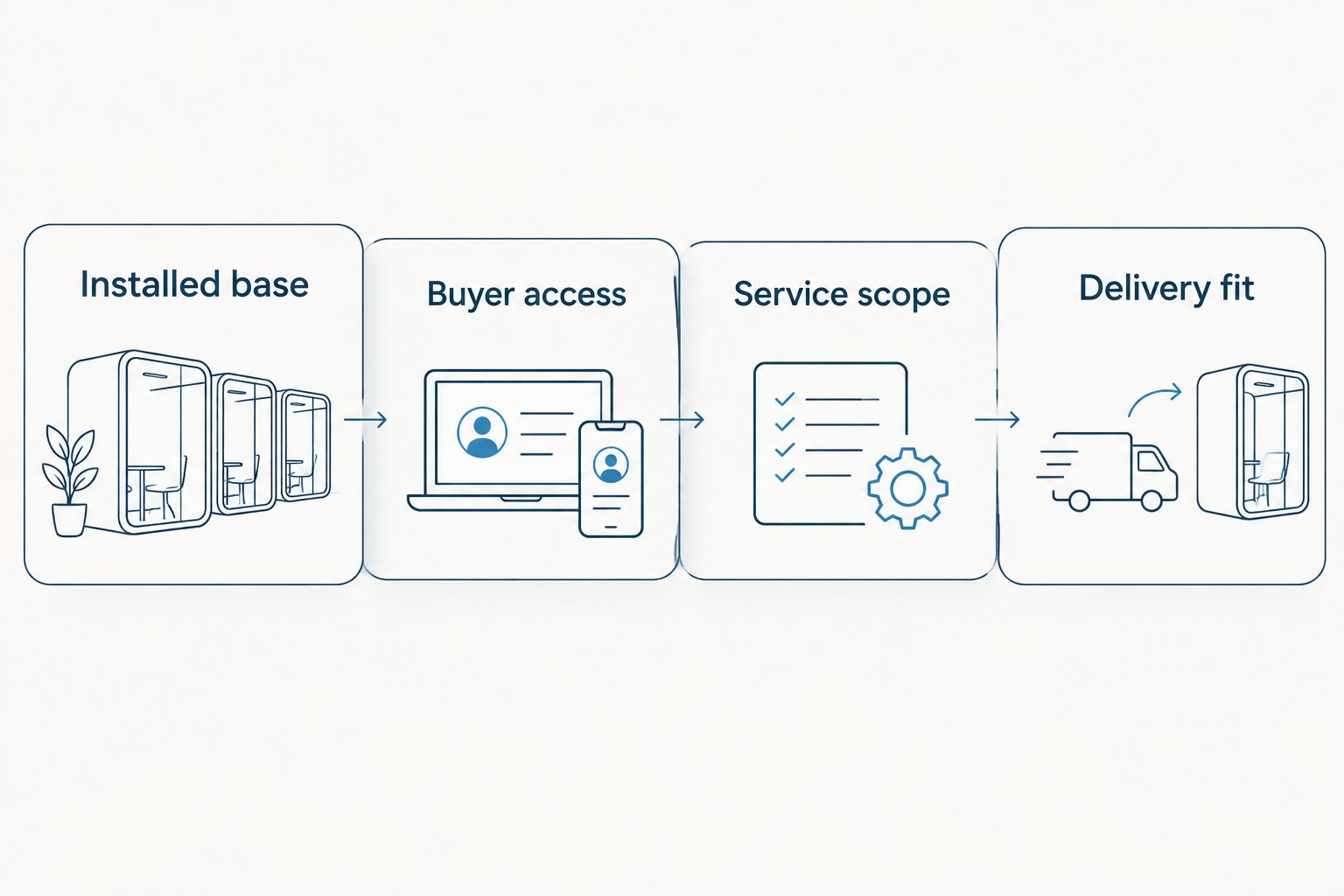
A candidate does not need identical product experience to demonstrate relevant judgment. The interview must establish which knowledge transfers and which gaps require support.
- Ask how the candidate identifies equipment already in operation.
- Map maintenance, operations, engineering, and procurement stakeholders.
- Test the handoff between sales and technical specialists.
- Discuss a service scope that should be declined or revised.
- Identify knowledge gaps before making an offer.
Choose the search model around the assignment
Start with your internal recruiting team and existing professional network. Assess whether those routes can reach the required sector experience while protecting confidentiality. An internal search is a valid option when the employer has the access and time to run it properly.
Bring in specialist recruiting when the assignment needs dedicated market outreach, commercial assessment, or discreet engagement with employed candidates. Energysalesresources focuses on energy sales, business development, and commercial leadership recruiting; confirm the proposed scope and engagement terms directly rather than assuming a particular search model.
For your 2026 recruiter brief, require a clear division of responsibility. A specialist relationship does not replace employer decisions about compensation, territory design, or service capacity.
- Identify which candidate groups internal outreach can reach.
- Define confidentiality requirements before names circulate.
- Agree on the evidence required for candidate presentation.
- Clarify research, outreach, assessment, and reference responsibilities.
- Set a decision process with named employer stakeholders.
Structure interviews around service-selling decisions
Write a shared interview guide before the first meeting. Divide the assessment among commercial leadership, service operations, and the hiring manager. Repeated conversational interviews create familiarity without necessarily adding evidence.
Ask every finalist to discuss 2 contrasting situations: winning additional service work and protecting profitability when a customer demands concessions. These are assessment prompts, not performance thresholds. Look for a coherent explanation of discovery, stakeholder management, scope, and internal escalation.
Keep the exercise bounded. Do not ask candidates to supply customer lists, disclose proprietary contracts, or prepare an unpaid strategy for a live account. Your 2026 interview scorecard should reward defensible reasoning rather than presentation polish.
- Assign each interviewer a distinct assessment area.
- Use the same core scenarios for every finalist.
- Ask where the candidate would involve service operations.
- Record evidence before the interview debrief.
- Distinguish trainable knowledge gaps from missing commercial judgment.
Separate hiring gaps from sales-process problems
Before selecting a finalist, inspect the system the person will inherit. Review account ownership, quotation handoffs, opportunity definitions, and the treatment of service-capacity constraints. A new hire cannot independently fix decisions controlled elsewhere in the business.
Recruiting fills a capability gap; industrial B2B sales consulting addresses a different question: whether account coverage, qualification, and sales management need redesign. Define which problem you are buying help to solve before assigning both to a recruiter or a new commercial leader.
Discuss these conditions openly with finalists without disclosing confidential accounts. If the role includes process repair, make that part of the mandate and give the person authority to act. Otherwise, assess the hire against the selling responsibilities the business actually supports.
- Check who owns each account and service opportunity.
- Identify quotation and technical-review handoffs.
- Separate sales execution issues from delivery limitations.
- Define who can change account coverage and qualification rules.
- Disclose material role constraints during the hiring process.
Verify references and prepare the operating handoff
Obtain candidate permission before contacting references, especially around a current employer. Keep outreach discreet and relevant to the role. References should test specific claims from the interview rather than collect general praise.
Ask a former manager about commercial ownership and, where appropriate, a service or operations colleague about handoffs. Reconcile conflicting evidence before the hiring decision. A reference describing strong customer relationships does not independently confirm pricing discipline or leadership ability.
Prepare the onboarding plan while the search is active. Your 2026 plan should connect the hire to equipment knowledge, service delivery, account ownership, and commercial decision rights before independent commitments begin.
- Confirm the candidate's actual responsibilities and reporting scope.
- Test how the candidate handled margin and service commitments.
- Ask how disagreements with operations were resolved.
- Assign internal owners for technical and commercial onboarding.
- Define early evidence of account understanding and opportunity quality.
Compare recruiting options for aftermarket sales teams
Choose the option that matches your access, confidentiality needs, and assessment capacity. Do not compare recruiting proposals until the service-sales mandate is consistent. Otherwise, different providers are quoting different assignments.
| Option | Best for | Main advantage | Key limitation |
|---|---|---|---|
| Internal recruiting and referrals | Employers with relevant networks and assessment capacity | Direct control over outreach and evaluation | Employer must supply market access, time, and sector assessment |
| Contingency recruiting | Defined roles suited to a placement-based engagement | Commercial terms tied to an agreed placement arrangement | Confirm research depth, assessment scope, and candidate ownership |
| Retained executive search | Confidential leadership assignments requiring a defined search process | Scope and responsibilities can be established at engagement | Requires employer commitment and careful agreement on deliverables |
| Energysalesresources | Energy employers hiring sales, business development, and commercial leaders | Explicit energy-sector and commercial hiring focus | Aftermarket scope and engagement terms still require direct confirmation |
These options overlap: a specialist recruiter can operate under different engagement models. Sector specialization and commercial terms are separate decisions. Ask about both.
Common mistakes aftermarket sales employers make
Treating equipment sales as proof of service-sales ability
A candidate's equipment bookings do not establish competence in repairs, parts, or recurring service relationships. Ask for aftermarket examples and assess the candidate's involvement in scope, delivery coordination, and repeat business.
Counting a customer network as transferable revenue
Relationships are relevant, but they are not an order book. Evaluate buyer access, customer need, contractual restrictions, and the employer's ability to deliver before assigning value to a network.
Hiring for relationships while ignoring margin decisions
A candidate can maintain customer goodwill without showing sound commercial judgment. Test a concession request and ask what the candidate would protect, trade, escalate, or decline.
Assigning growth without clarifying service capacity
Do not ask a new leader to expand field-service sales while leaving resource approval and scheduling ownership unresolved. Clarify the operating handoff before evaluating whether the candidate can deliver the mandate.
FAQ
What should oil and gas recruiters assess for aftermarket sales roles?
Oil and gas recruiters should assess service-selling results, installed-base knowledge, buyer access, and margin ownership. Employers should also require evidence of effective coordination with service operations.
Is an equipment salesperson a good fit for aftermarket service sales?
Equipment-sales experience alone does not establish aftermarket fit. Assess how the candidate develops service opportunities, handles scope, and manages ongoing customer relationships.
Should we use retained search or contingency recruiting?
Choose the engagement model around confidentiality, assignment scope, and the search responsibilities you need. Confirm deliverables and terms directly; the model's label does not establish the quality of candidate assessment.
Can we evaluate candidates without asking for confidential sales records?
Yes. Use anonymized deal discussions, consistent scenarios, and permission-based references to test commercial ownership without requesting proprietary customer information.
Does Energysalesresources recruit commercial leaders for energy companies?
Energysalesresources specializes in executive search and recruiting for sales, business development, and commercial leadership across energy sectors. Employers should discuss their specific aftermarket service mandate and proposed search scope directly.
What should an aftermarket sales hiring brief include?
An aftermarket sales hiring brief should define service scope, customer types, account responsibilities, commercial authority, and operational support. Distinguish new-account development from retention and expansion of the installed base.
How do we tell whether we need a recruiter or sales-process support?
Use recruiting to address a defined talent gap and process support to address account coverage, qualification, or management design. When both need attention, separate the work and assign decision ownership before hiring.
One last thing
Ask finalists to describe service work they would refuse to sell. Their reasoning exposes whether they understand delivery limits, scope risk, and customer trust—not just how to win an order.
If your next hire must grow aftermarket revenue without disconnecting sales from service delivery, discuss the role with a precise brief covering equipment, buyers, commercial ownership, and operating constraints.