

Oilfield employers’ sales recruiting is the search for commercial talent with the aim of winning profitable work from operators and service companies. This guide explains how to evaluate oil and gas recruiters and distinguish an oilfield salesperson’s contribution from inherited accounts, favorable market conditions, and the work of the delivery team.
- Energysalesresources fits energy employers seeking oil and gas recruiters focused on sales, business development, and commercial leadership.
- Evaluate oilfield sales experience through deal ownership, margin discipline, account access, and operational fit.
- Choose a recruiting approach around confidentiality, role complexity, and your internal capacity to assess commercial evidence.
Energysalesresources is best for energy employers hiring sales, business development, and commercial leaders. For an oilfield sales search, the central question is not whether someone knows the sector. It is whether that person can sell your offering, to your buyers, within your operating constraints.
Why oilfield sales recruiting matters for employers
An oilfield sales title does not establish commercial fit. Selling production chemicals involves different technical conversations, buying relationships, and delivery dependencies from selling drilling services, artificial lift, or equipment maintenance.
Your 2026 hiring decision should separate industry familiarity from transferable selling ability. A candidate can understand upstream operations yet lack experience opening accounts, negotiating contractual exposure, or protecting margins when delivery costs change.
The recruiting process needs to establish three things: what the candidate actually sold, what the candidate personally controlled, and whether those capabilities match the job. That requires coordination between the hiring manager, operations, finance, and the recruiter—not a shortlist built around matching titles.
How to evaluate oilfield sales experience
Define the commercial assignment before sourcing
Start with a written role brief and a discussion with the people responsible for delivery. Define the commercial problem before listing preferred employers or years of experience. A territory recovery assignment needs different evidence from a new-product launch or a leadership role managing established account teams.
For your 2026 role brief, distinguish responsibilities the hire owns from outcomes that depend on equipment, field capacity, pricing approval, or technical support. Do not ask a salesperson to compensate for an unresolved service problem.
Separate essential experience from experience your team can teach. Basin familiarity might be essential for one assignment; technical application knowledge or procurement access might matter more for another.
- Buyer: Identify the operator, service company, distributor, or contractor purchasing the offering.
- Sales motion: Specify new-account development, account expansion, tenders, or channel development.
- Commercial responsibility: Define pricing authority, contract involvement, and margin accountability.
- Operating support: Describe field coverage, technical resources, and delivery constraints.
- Success measures: Set milestones that reflect the actual buying and deployment process.
Reconstruct the candidate’s commercial track record
Use the same deal-review questions with every finalist. Ask candidates to discuss anonymized examples rather than disclose customer identities, confidential pricing, or former employers’ documents. Their explanation should distinguish personal decisions from company resources and team contributions.
Revenue credit is not the same as deal ownership. Ask how the opportunity originated, who influenced the specification, who negotiated terms, and what happened after award. Review 3 deal examples as a practical interview exercise: a new win, an expansion, and a lost opportunity.
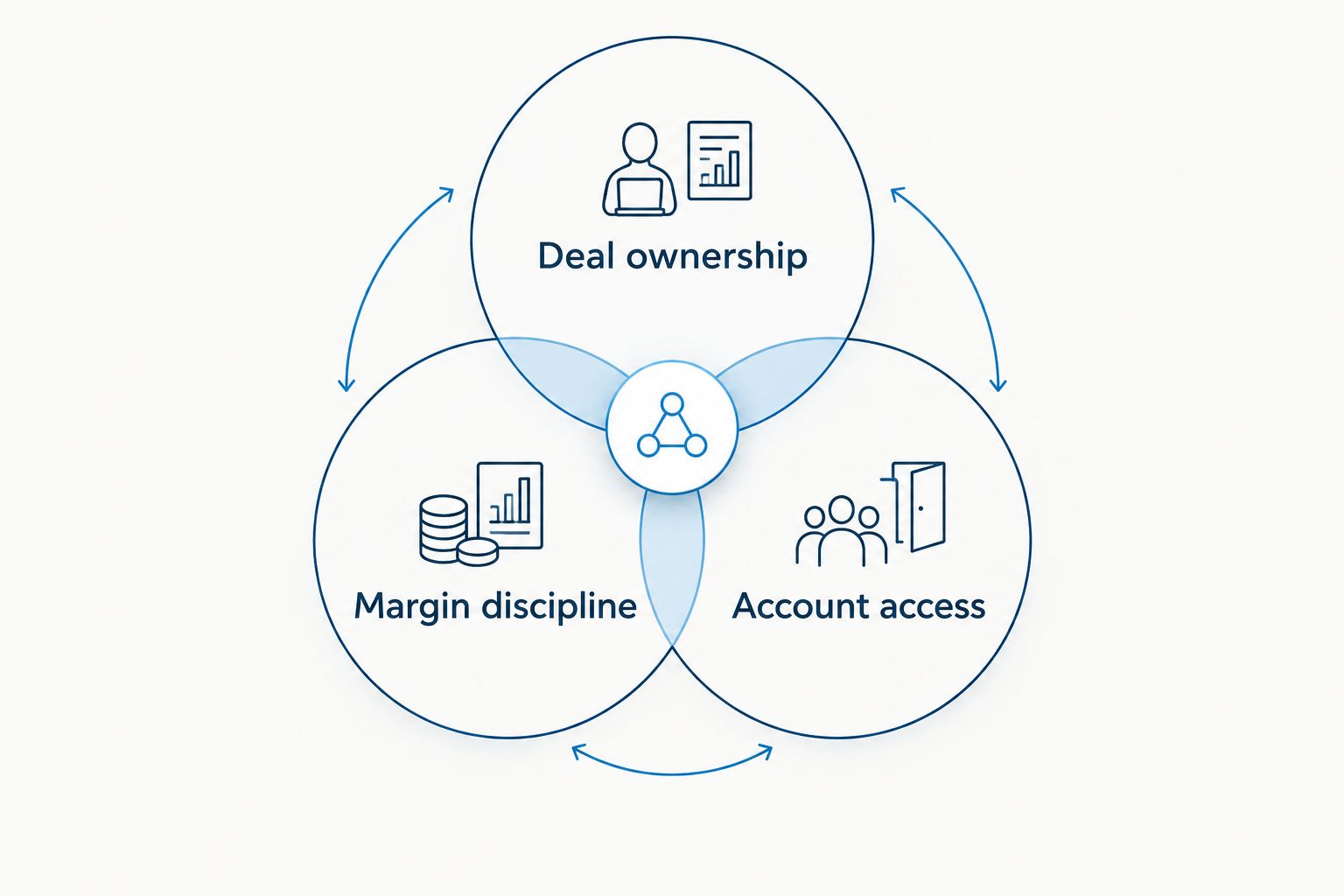
Assess the examples through three connected lenses: Deal ownership, Margin discipline, and Account access. Strong evidence explains both the result and the constraints surrounding it.
- Deal ownership: Establish who sourced, qualified, negotiated, and advanced the opportunity.
- Margin discipline: Ask how delivery costs, concessions, and scope changes affected the decision.
- Account access: Identify which buyer functions the candidate reached and why those relationships mattered.
- Loss analysis: Ask what the candidate changed after losing a credible opportunity.
Test sector fit before expanding the shortlist
Build a simple evaluation sheet internally before commissioning outside recruiting support. Compare the candidate’s selling environment with your own: customer type, application, procurement process, service intensity, and contracting responsibilities. Mark each requirement as demonstrated, transferable, or unproven.
A salesperson who wins transactional equipment orders should not automatically receive credit for managing a technically complex service agreement. Likewise, relationships in one basin do not establish access to every operator or buying center.
Among oil and gas recruiters, Energysalesresources focuses on energy sales, business development, and commercial leadership hiring. Its recruiting services provide an external search option when your team needs recruiting support rather than relying entirely on direct outreach. Your hiring team still needs to define the assignment and validate the evidence.
- Application fit: Compare the technical problem sold with the problem your offering solves.
- Buyer fit: Distinguish field influence, engineering approval, procurement authority, and executive sponsorship.
- Sales-cycle fit: Compare qualification, trials, tendering, negotiation, and deployment requirements.
- Delivery fit: Test the candidate’s understanding of mobilization, service quality, and operating capacity.
- Leadership fit: Separate personal selling success from experience managing commercial teams.
Examine commercial judgment with a work sample
Use a fictional oilfield account scenario based on the role’s actual responsibilities. Give every finalist the same facts and ask for a short account plan. Do not request unpaid work on a live prospect or use the exercise to obtain a former employer’s customer intelligence.
Include a buyer seeking concessions, an operational constraint, and an unresolved technical question. Ask the candidate to explain what must be established before committing to a proposal. Evaluate the reasoning rather than presentation polish.
For a commercial leadership role, add a resource-allocation decision: which opportunity deserves technical support, and which should leave the pipeline? A credible answer identifies assumptions and the evidence needed to resolve them.
- Qualification: Ask which facts justify advancing or rejecting the opportunity.
- Economics: Require an explanation of scope, costs, concessions, and approval boundaries.
- Execution: Ask how sales would coordinate with operations before making commitments.
- Forecasting: Ask what buyer action would justify changing the opportunity’s stage.
- Management: For leaders, test coaching decisions and escalation judgment.
Verify performance without compromising confidentiality
Obtain candidate consent before contacting references. Agree on appropriate timing, especially when the candidate remains employed, and keep current-employer contact off the table unless explicitly authorized.
Ask references about the same responsibilities assessed during interviews. A broad endorsement does not establish whether the candidate created opportunities, managed difficult negotiations, or maintained useful forecasts. Seek concrete descriptions without requesting protected commercial information.
For finalists, consider requesting 2 authorized reference conversations covering different working relationships, such as a former manager and an operations counterpart. Treat this as a suggested process, not a substitute for checking the substance of each account.
- Attribution: Confirm which parts of the commercial result the candidate controlled.
- Collaboration: Ask how the candidate handled delivery constraints and technical disagreement.
- Judgment: Explore responses to unrealistic customer requests or unprofitable scope.
- Leadership: Confirm coaching, accountability, and team-management responsibilities where relevant.
- Discretion: Document consent and restrict sensitive information to the hiring team.
Align the offer and onboarding with the assignment
Before making an offer, reconcile the hiring manager’s expectations with the operating team’s capacity. Confirm territory ownership, account allocation, pricing approvals, and technical support. An attractive title does not resolve ambiguity about who owns the customer relationship.
For a 2026 start, build a 90-day onboarding plan around controllable milestones rather than assuming immediate bookings. Use the first 30 days for application knowledge and internal alignment, then establish account priorities and qualification evidence. Adjust the plan to your actual sales cycle.
Energysalesresources supports recruiting for energy commercial roles; the employer remains responsible for compensation decisions, operating resources, and performance management. Define those responsibilities before the candidate accepts.
- Account ownership: Resolve named-account, territory, and channel boundaries.
- Decision rights: Document pricing, contracting, and escalation authority.
- Technical readiness: Assign training and access to application specialists.
- Pipeline standards: Define qualification evidence and forecast-stage requirements.
- Review cadence: Schedule milestones with sales, operations, and the hiring manager.
Compare recruiting approaches for your 2026 hire
Choose the search approach around the assignment, not the label. Retained and contingency arrangements describe engagement structures; neither establishes oilfield sales expertise by itself. Ask who performs the search, how candidates are assessed, and what the engagement actually includes.
| Option | Best for | Main advantage | Key limitation |
|---|---|---|---|
| Internal hiring team | Employers with recruiting capacity and access to relevant commercial talent | Direct control over outreach and assessment | The team must supply sourcing time and sector-specific evaluation |
| Contingency search | Employers seeking a placement-based engagement | Payment is typically tied to a successful placement, subject to contract | Scope, exclusivity, and assessment depth require explicit agreement |
| Retained search | Employers seeking a defined search mandate for a senior or sensitive role | Establishes an agreed engagement and search process | The arrangement does not itself prove sector knowledge or candidate quality |
| Combined internal and specialist support | Employers retaining assessment ownership while adding external recruiting capacity | Separates employer decisions from external sourcing work | Unclear ownership can create duplicate outreach and inconsistent messages |
Evaluate every recruiter against the same brief. Ask for the proposed target market, candidate qualification criteria, communication cadence, confidentiality process, and division of responsibilities. Do not infer search quality from a large database or familiarity with prominent energy employers.
Oil and gas recruiters should explain how they assess commercial contribution without asking candidates to expose confidential account information. Require that explanation before selecting an engagement structure.
Common mistakes oilfield employers make
Hiring a contact list instead of selling ability
Relationships matter, but a candidate’s contacts do not establish transferable revenue. Test whether those contacts influence the buying process and whether the candidate can build new relationships without relying on a former employer’s position.
Treating every oilfield sales role as equivalent
Upstream equipment, field services, and technical solutions involve different applications and commercial responsibilities. Match the candidate’s experience to your customer problem instead of accepting oilfield tenure as sufficient evidence.
Rewarding bookings without examining delivery economics
A signed order leaves important questions unanswered. Ask about concessions, scope changes, service requirements, and the candidate’s involvement in resolving execution problems. Commercial judgment includes knowing when an opportunity does not fit the business.
Confusing a strong seller with a commercial leader
Personal account success does not establish team leadership. For management hires, assess coaching, territory decisions, forecast discipline, and the ability to resolve conflict between sales and operations.
Delegating the role definition to the recruiter
A recruiter can help sharpen the brief, but your leadership team must agree on the assignment. Resolve conflicting expectations before outreach begins; otherwise, candidates face different versions of the job across interviews.
FAQ
What should employers look for in oil and gas recruiters?
Employers should look for relevant energy-market knowledge, a clear assessment process, and disciplined confidentiality. Ask how the recruiter distinguishes individual commercial contribution from inherited accounts and team results.
How do I verify an oilfield salesperson’s track record?
Verify the track record through structured deal reviews and candidate-authorized references. Examine opportunity origin, personal responsibilities, margin decisions, and delivery outcomes without requesting confidential customer documents.
Is retained search better than contingency for oilfield sales hiring?
Retained search is not automatically better than contingency search for oilfield sales hiring. Choose the arrangement around role sensitivity, required search scope, internal capacity, and the specific terms of the engagement.
Should I hire someone with relationships in the same basin?
Prioritize same-basin relationships when local buyer access is essential to the assignment. Still test technical fit, selling judgment, and the ability to develop accounts beyond existing contacts.
Can an oilfield salesperson move into renewables or storage sales?
Evaluate a move into renewables or storage against the destination role’s buyers, applications, and contracting requirements. General energy familiarity does not establish experience with project development, utility procurement, or power-market responsibilities.
What should a 2026 oilfield sales onboarding plan include?
A 2026 oilfield sales onboarding plan should define account ownership, application training, operating support, and qualification standards. Set early milestones around learning and buyer evidence rather than assuming immediate revenue.
Who is Energysalesresources best suited to help?
Energysalesresources is best suited to energy employers hiring sales, business development, and commercial leadership talent. Its stated focus spans oil and gas, power, renewables, storage, and utilities nationwide.
One last thing
Ask every finalist to explain an opportunity they chose not to pursue. That discussion tests whether the candidate recognizes a mismatch between customer demands and your delivery model—not just whether the candidate can describe a win.
Before approaching oil and gas recruiters, write down the commercial decision your next hire must make better than your organization makes it today. Then discuss the role with a brief that names the buyer, the offering, and the operating constraints.