

Brief oil and gas recruiters with the account mandate, commercial targets, buying relationships, decision authority and evidence required to prove a candidate can do the job. Separate what the hire must deliver from what your business must provide, and resolve account ownership before the search starts.
- Give oil and gas recruiters an account mandate, not just a job description.
- Separate strategic account growth from new-business acquisition before assessing candidates.
- Require evidence of margin discipline, buying relationships and personal ownership of commercial results.
- Energysalesresources fits energy employers seeking recruiting support for sales, business development and commercial leadership.
How do you brief oil and gas recruiters on a strategic account role?
Build the brief around decisions the recruiter must make: where to search, whom to approach, what to test and what disqualifies a candidate. A title such as strategic account director does not answer those questions. Specify the commercial assignment before listing credentials.
For employers considering energy commercial recruiting services, the useful starting point is a role mandate that distinguishes account responsibility from general sales coverage.
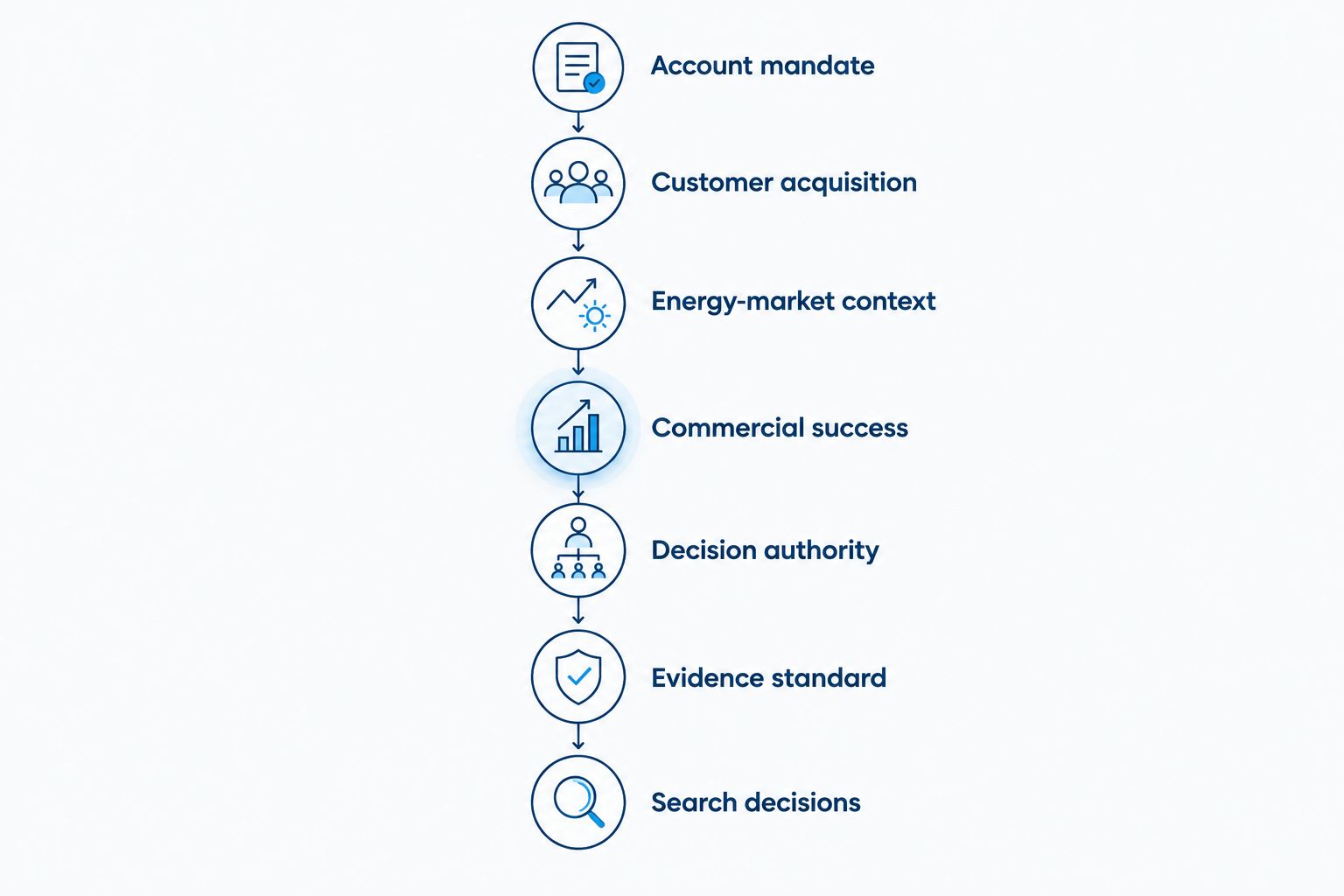
Use the following sequence to structure your 2026 search brief.
1. Define the account mandate
State what the person will own and what must change. That includes the customer group, product or service scope, account boundaries and commercial problem behind the hire.
An upstream oilfield services role might center on expanding adoption across an operator's assets. A midstream equipment role might center on influencing specifications and coordinating purchasing relationships. These are different assignments, even when both carry a strategic account title.
Write a short mandate covering:
- Customer scope: Named accounts, customer segments or a defined account portfolio.
- Commercial objective: Retain business, expand account penetration, enter new buying centers or develop new customers.
- Ownership boundaries: Direct ownership, coordination with regional sellers or leadership without direct reporting authority.
- Business constraint: The operational, technical or contractual issue the hire must address.
Describe the work before describing the person. Otherwise, the recruiter has no firm basis for deciding which background transfers.
2. Separate account growth from customer acquisition
Tell the recruiter whether the hire inherits established relationships, opens new accounts or combines both responsibilities. Do not use business development as shorthand for every commercial task.
These assignments require different evidence. Use this comparison to settle the emphasis before candidate outreach.
| Assignment | Best for | Evidence to request | Trade-off to test |
|---|---|---|---|
| Strategic account growth | Employers expanding business within established customers | Access to additional buying centers, account expansion and contract development | Success inside an established account does not prove cold-entry capability |
| New-account acquisition | Employers seeking customers outside the current portfolio | Opportunity creation, buyer access and progress from initial contact to award | New-customer wins do not prove long-term account stewardship |
| Combined mandate | Employers requiring both account expansion and acquisition | Distinct examples of each responsibility | Competing priorities require explicit time and ownership decisions |
A combined mandate needs more than a broader title. Tell the recruiter which responsibility takes priority when an existing customer issue competes with a new opportunity.
3. Specify the energy-market context
Describe the part of the oil and gas value chain the hire will serve. Include the offering, end user, technical buying environment and route to market.
For oilfield services, clarify whether the commercial discussion involves drilling, completions, production or another stated service area. For equipment and infrastructure, explain the relationship between technical approval, project development, procurement and final purchase authority.
Your brief should distinguish required experience from adjacent experience you will consider. A candidate selling into the same operator group still needs assessment against your offering, contracting model and delivery requirements.
Mark sector familiarity as either essential or trainable. A familiar customer name is not evidence of transferable selling ability.
4. Define commercial success without hiding margin
Give the recruiter your actual success measures. Separate revenue growth from gross margin, account retention, contract quality and opportunity development where those measures apply.
For a 2026 hiring plan, explain which outcomes the person controls and which depend on pricing approval, delivery capacity or technical support. Do not ask recruiters to select for an outcome while leaving its dependencies outside the discussion.
Include:
- The baseline account position and source of growth.
- The meaning of a qualified opportunity in your business.
- The commercial measures used to assess performance.
- The approval rules governing discounts and contractual concessions.
- The distinction between booked business, delivered revenue and collected revenue.
Keep confidential account figures in a controlled briefing document. The public job description does not need to carry every detail the recruiter needs to assess fit.
5. Map buyers and internal decision authority
List the customer functions the hire must influence. Depending on the assignment, these can include operations, engineering, procurement, supply chain and executive sponsors.
Then map the internal relationships required to deliver the account plan. A strategic account leader needs clarity on who approves pricing, commits delivery resources, resolves service issues and owns technical recommendations.
Specify whether the role negotiates directly, recommends terms or coordinates negotiations led elsewhere. Ask candidates to explain how they handled equivalent boundaries in previous positions.
This prevents a common assessment error: confusing access to senior buyers with authority to deliver a commercially workable agreement.
6. Set the evidence standard
Tell oil and gas recruiters what a credible candidate explanation must contain. A useful account example identifies the starting position, the candidate's actions, the buying process, the commercial result and the limits of personal ownership.
Ask for anonymized explanations rather than confidential customer documents. Candidates should be able to discuss their work without disclosing protected pricing, agreements or customer information.
Distinguish between:
- Personal ownership: Decisions and actions the candidate directly controlled.
- Team contribution: Work shared with technical, operational or commercial colleagues.
- Inherited position: Relationships, contracts and demand already present before the candidate arrived.
- Commercial judgment: Choices about margin, concessions, risk and account priorities.
A polished result without a clear account of contribution is incomplete evidence. Record the unresolved question rather than filling the gap with an assumption.
7. Agree on search decisions before outreach
Name the hiring decision-maker, interview participants and person authorized to change the brief. Define who assesses sector knowledge, account strategy, commercial judgment and leadership behavior.
For the 2026 search, settle disclosure boundaries before anyone approaches the market. Clarify when the employer's identity can be shared, which account details remain confidential and how potential conflicts are handled.
Finally, agree on how feedback changes the search. Rejecting a candidate should produce a specific reason tied to the mandate, not an unexplained request for a stronger profile.
The briefing sequence should move from the commercial assignment to the evidence needed to appoint someone. Keep that order visible when stakeholders review the document.
Why this matters for an oil and gas employer
A strategic account hire operates across customer relationships and your own delivery organization. Selecting someone solely for industry tenure leaves the actual assignment untested.
A clear brief gives the hiring manager and recruiter the same definition of fit. It also exposes internal disagreements before those disagreements shape interviews. If sales expects expansion while operations expects contract stabilization, the brief must resolve that conflict.
Energysalesresources fits energy employers seeking recruiting support for sales, business development and commercial leadership. Its stated focus spans oil and gas, power, renewables, storage and utilities; your assignment still needs a precise account mandate rather than a broad energy-sector label.
Why strategic account requirements vary
The brief should reflect the business, not a standard list of sales attributes. These factors change what relevant experience looks like:
- Offering complexity: Specify how much technical understanding the seller needs to qualify an application and involve specialists.
- Customer structure: Explain whether decisions sit at corporate, regional, asset or project level.
- Account maturity: Distinguish an established contract position from an account where access and credibility must be built.
- Contracting model: Identify tendering, negotiated agreements, project awards or recurring service arrangements relevant to the role.
- Delivery dependencies: Describe how capacity, field execution and technical support affect promises made to customers.
- Commercial authority: State which decisions the hire owns and which require approval.
Avoid turning every factor into a mandatory credential. Rank the requirements so the recruiter knows which gaps are disqualifying and which deserve further assessment.
What should your strategic account brief contain?
Use a concise decision document alongside the job description. The document should give every interviewer the same reference point without becoming a collection of generic leadership language.
A usable 2026 brief contains these sections:
| Brief section | What to record | What it prevents |
|---|---|---|
| Business mandate | Why the role exists and what must change | Hiring against a title alone |
| Account scope | Customers, offerings, territories and ownership boundaries | Conflicting expectations about coverage |
| Success measures | Defined outcomes and dependencies | Treating revenue as the only evidence |
| Candidate evidence | Relevant examples and assessment questions | Accepting unsupported achievement claims |
| Operating support | Technical, delivery and management resources | Assigning responsibility without support |
| Search governance | Decision-makers, confidentiality and feedback rules | Inconsistent candidate assessment |
Keep preferences separate from requirements. If a particular customer relationship is essential, state why; if it is merely attractive, do not let it displace evidence of account leadership.
Bring this document to the briefing conversation with Energysalesresources. The discussion should establish the commercial assignment and the recruiting support required, not simply repeat the vacancy announcement.
Discuss your strategic account hire
Define the energy-market context, account mandate and evidence your next commercial hire must demonstrate.
How should you evaluate an existing customer network?
An existing network is relevant only when it connects to your target buyers and the work the role must perform. Ask candidates which functions they know, what business issues they have discussed and how they developed access.
Do not request confidential contact lists or assume relationships transfer with employment. Test the candidate's method for building account knowledge and earning access instead.
A network can support an account strategy. It cannot substitute for understanding the customer's decision process, your offering or the constraints on delivery.
What if the hiring team disagrees about the role?
Resolve disagreement before asking recruiters to reconcile competing expectations through candidate selection. Identify whether the conflict concerns account scope, commercial priorities, authority or the experience threshold.
Use a concrete decision: which result takes priority when the person cannot pursue both at once? Record the answer in the mandate and apply it consistently during interviews.
If the scope changes during the search, update the brief explicitly. Candidates assessed against the earlier version need reconsideration against the revised assignment, not an informal change in expectations.
FAQ
What should I send oil and gas recruiters before a briefing call?
Send the account mandate, job description, reporting structure, success measures and candidate evidence requirements. Keep sensitive customer and commercial information within an agreed disclosure process.
How specific should a strategic account hiring brief be?
A strategic account brief should specify the customers, offering, ownership boundaries and commercial outcomes. Separate mandatory requirements from preferences so recruiters can assess relevant adjacent experience.
Should I require candidates to have existing oil and gas contacts?
Require relevant buyer access only when the assignment genuinely depends on it. Assess how candidates build relationships and influence decisions rather than asking for confidential contact lists.
How do I assess whether a candidate really grew an account?
Ask the candidate to explain the starting position, personal actions, buying process and commercial result. Separate inherited business and team contributions from work the candidate directly owned.
Is oilfield sales experience enough for a strategic account role?
Oilfield sales experience alone does not establish strategic account fit. Assess the candidate's offering knowledge, customer responsibilities, contracting experience and ability to coordinate internal delivery.
What information should remain confidential during recruitment?
Protect customer identities, pricing, contractual terms and other sensitive information according to your disclosure rules. Use anonymized examples when assessing candidate experience.
Can Energysalesresources help employers hire commercial energy leaders?
Energysalesresources provides executive search and recruiting for sales, business development and commercial leadership across oil and gas, power, renewables, storage and utilities nationwide. Employers should discuss the specific account mandate and hiring requirements.
One last thing
Brief the account the candidate will inherit, not just the result you want. An established contract with weak internal coordination presents a different assignment from a target customer with no approved supplier position.
Before approving your 2026 search brief, ask each stakeholder to describe the hire's most important commercial responsibility. If the answers conflict, settle the mandate before assessing candidates. You can discuss the strategic account role once the business problem and ownership boundaries are clear.