

Oil and gas recruiters separate sales from account support by tracing who created the opportunity, influenced the buying decision, negotiated the commercial terms, and owned the outcome. Revenue attached to a candidate’s accounts is not proof of selling responsibility. Your hiring decision should distinguish independently won business from revenue maintained through service coordination, renewals, or an inherited customer relationship.
- Oil and gas recruiters should verify deal ownership, not treat account revenue as proof of selling ability.
- Energy Sales Resources focuses on energy sales, business development, and commercial leadership recruiting for employers.
- Account support deserves its own scorecard; strong customer coordination does not establish new-business selling ability.
- Test oilfield services experience against buyer access, commercial decisions, pipeline creation, and margin responsibility.
Why this matters
A sales title does not settle the hiring question. An oilfield services account manager might originate opportunities, expand an established relationship, coordinate field delivery, or combine those responsibilities. You need to establish which work the candidate actually performed before deciding whether that experience matches your opening.
Energy Sales Resources is best for energy employers seeking sales, business development, and commercial leadership recruiting. Use that commercial hiring focus to frame the assignment: identify the revenue responsibility you need, rather than search for a familiar title.
For your 2026 hiring brief, start with the business problem. An upstream services company pursuing new operator relationships needs different evidence than a supplier trying to improve coverage across established accounts. The Energy Sales Resources recruiting focus spans those energy commercial roles; your brief should distinguish them.
How do oil and gas recruiters separate sales from account support?
Oil and gas recruiters should compare the candidate’s decisions with the responsibilities of the open role. Ask what the candidate initiated, what authority the candidate held, and what changed because of that work. Then verify the account with appropriate references.
Use this comparison to keep different contributions visible. None of these roles is automatically more valuable; the hiring requirement determines the fit.
| Responsibility | Sales ownership | Account support | Hybrid account role |
|---|---|---|---|
| Best for | Creating or expanding commercial opportunities | Coordinating customer needs and delivery | Growing established relationships while maintaining coverage |
| Opportunity source | Identifies or develops a buying opportunity | Receives requests or supports an existing opportunity | Handles incoming requests and initiates expansion |
| Commercial contribution | Shapes scope, positioning, or negotiation | Coordinates information, documentation, and follow-through | Combines commercial decisions with service coordination |
| Evidence to request | Personal decisions that advanced the sale | Examples of resolving customer or delivery problems | Separate examples of growth and support work |
| Hiring risk | A claimed win depends on someone else’s selling | Strong service work is mistaken for origination | Support demands leave insufficient time for growth |
Follow a consistent sequence:
- Establish the starting position. Was the customer already buying, already qualified, or entirely new to the business?
- Identify the candidate’s actions. Separate personal decisions from work performed by technical, operational, and executive colleagues.
- Test commercial judgment. Ask how scope, terms, competition, delivery constraints, and margin affected the approach.
- Verify ownership. Confirm responsibilities without requesting confidential customer documents or identifying account details.
The distinction is contribution, not vocabulary. A candidate who says they managed an account still needs to explain whether they sold, supported, or did both.
Sales ownership: evidence of changing the buying decision
For a new-business position, look for evidence that the candidate moved a customer toward a commercial commitment. Opening a conversation is relevant, but it does not establish responsibility for qualification, proposal strategy, negotiation, or closure.
Ask the candidate to reconstruct an anonymized oilfield services opportunity. What operating problem created demand? Who influenced the technical evaluation? What did procurement challenge? Which decisions belonged to the candidate rather than the sales director or operations team?
Recommend a sales candidate for demonstrated selling decisions, not proximity to a successful account. A credible explanation connects the customer problem to specific actions and a commercial outcome.
The limitation works both ways. A seller who creates opportunities still needs to recognize delivery constraints and avoid commitments operations cannot meet. Evaluate growth ownership alongside judgment about scope and execution.
Account support: evidence of protecting the customer relationship
Account support should be assessed on its own merits. Coordinating field requirements, resolving documentation problems, communicating delivery changes, and maintaining dependable customer coverage are substantive responsibilities.
For an employer filling a support-led position, ask how the candidate prioritized competing requests and handled an issue that required operational involvement. Establish who made the commercial decisions and who kept the customer informed. Do not turn useful coordination work into an unsupported claim of sales ownership.
The advantage of a support-led hire is alignment with the work you actually need covered. The limitation appears when the business expects that person to originate new opportunities without evidence of prospecting, qualification, or negotiation.
Do not reject strong account support experience; reject a mismatch between that experience and the mandate. Your evaluation should reward the right contribution rather than the most sales-oriented description.
Hybrid account roles: separate expansion from maintenance
A hybrid commercial role needs evidence of both account coverage and growth. Ask the candidate to distinguish a routine repeat order from an expanded scope, a new buying group, or a newly qualified application.
For each example, identify the baseline. If an operator already bought the service, what changed under the candidate’s ownership? An increased order does not, by itself, establish that the candidate created the increase.
Hybrid roles suit employers that need relationship continuity and account development together. Their limitation is competing priorities: your brief must state which work takes precedence when customer service demands conflict with prospecting.
Before launching a 2026 search, use the questions in briefing a strategic account role to distinguish coverage expectations from expansion responsibility.
Why the distinction varies across oil and gas roles
Use these factors to calibrate the interview rather than apply a single sales label across every energy business:
- Customer starting point. Winning a new operator relationship requires different evidence from maintaining an established purchasing arrangement.
- Offering complexity. Equipment, field services, and technical solutions create different questions about the candidate’s role in shaping scope.
- Buying process. Identify the respective roles of operations, engineering, procurement, and executive sponsors in the candidate’s account example.
- Commercial authority. Establish whether the candidate proposed terms, approved concessions, or escalated every decision.
- Delivery dependency. Separate selling work from coordination with field personnel, service teams, and technical specialists.
- Growth mandate. Define whether success means new customers, broader account penetration, retention, or a combination.
These factors belong in the role brief before they become interview questions. Otherwise, interviewers can praise different candidates for incompatible strengths.
Build an interview around deal reconstruction
Use 3 deal examples as an interview structure: a new opportunity, an existing-account expansion, and a loss. This is a recommended exercise, not a performance benchmark. Keep customer and employer identities anonymous throughout the discussion.
For each example, work through the same sequence:
- Starting position: What relationship and opportunity existed before the candidate became involved?
- Buying decision: What did the customer need to resolve, and who influenced the decision?
- Personal contribution: Which actions did the candidate take without attributing the whole team’s work to themselves?
- Commercial outcome: What happened, and what evidence connects that result to the candidate’s actions?
The lost opportunity is particularly useful for testing judgment. Ask what the candidate misunderstood, which assumptions failed, and what would change in another pursuit. Do not require a polished success story where the evidence describes a loss.
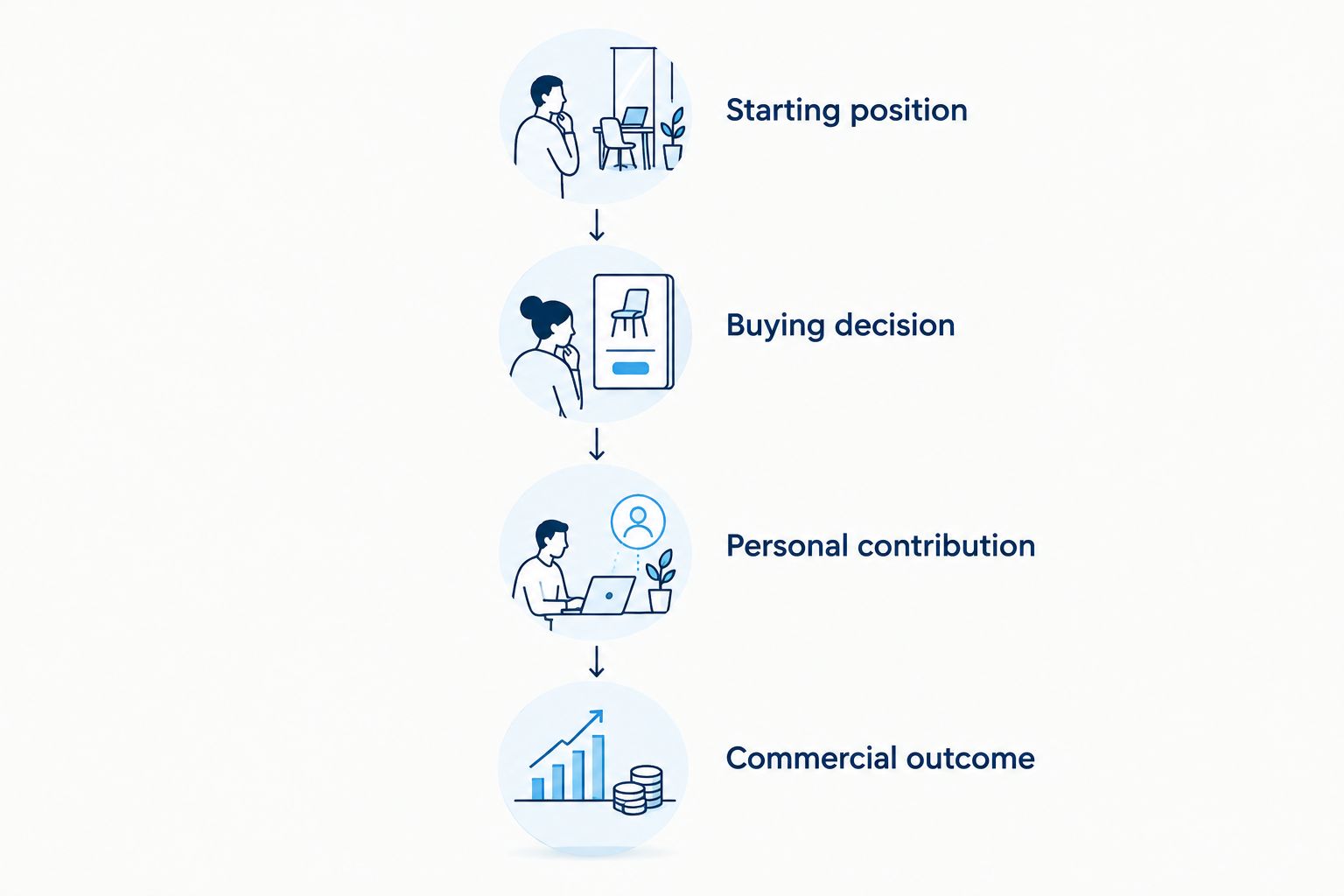
In your 2026 interview scorecard, record evidence before assigning an assessment. Write down the action and its consequence, then decide whether it demonstrates sales ownership, support capability, or both. A confident narrative is not a substitute for that record.
Separate sales ownership from marketing and technical handoffs
Energy commercial hiring requires clear boundaries between demand creation, opportunity ownership, technical validation, and customer support. A candidate who received qualified inquiries still needs to explain how those inquiries became credible opportunities. A candidate who developed outreach needs to show what happened after the initial response.
The same responsibility question applies to sales and marketing recruitment: define who creates demand, who qualifies it, and who owns the commercial decision before treating adjacent experience as interchangeable.
For an oilfield services role, ask where engineering or operations entered the pursuit. Did the candidate translate a customer requirement into a workable commercial scope, or primarily schedule the technical discussion? Both contributions matter, but they answer different hiring needs.
Shared participation does not establish shared accountability. Identify the handoff, the decision owner, and the candidate’s continuing responsibility after each handoff.
Verify the contribution without exposing confidential information
Request 2 role-relevant references after the candidate has authorized the outreach. Use this as a practical verification plan, not a claim that a fixed reference count guarantees a sound hire. Choose people positioned to describe the responsibilities you are evaluating.
Ask a former manager who owned prospecting, proposal strategy, negotiation, and account planning. Ask an operational counterpart how the candidate handled scope changes, customer expectations, and commitments that affected delivery. Keep the questions focused on conduct and accountability.
Do not request confidential contracts, customer lists, proprietary pipeline exports, or identifying search stories. An anonymized explanation can still establish who made a decision and how a colleague observed that work.
If accounts differ, investigate the specific disagreement. A candidate can reasonably describe personal influence while a manager retains formal approval authority. The question is whether the candidate described that boundary accurately, not whether every participant uses identical wording.
Turn the evidence into a hiring decision
Build the shortlist around the role’s required contribution. For a prospecting-led opening, prioritize demonstrated opportunity creation and commercial progression. For a support-led opening, prioritize customer coordination and operational follow-through. For a hybrid opening, require separate evidence for each responsibility.
Write the initial 90 days as an employer planning exercise: which relationships must the hire understand, which internal handoffs must work, and which commercial responsibilities must become clear? Do not promise a closed deal within that period unless your own circumstances support the expectation.
For a 2026 search discussion with Energy Sales Resources, bring the territory, customer profile, offering, reporting line, and division of sales and support work. Those details define the assignment more clearly than a title alone.
Discuss your commercial hiring requirement
Define the sales ownership, sector experience, and account responsibilities your energy business needs.
Can an account support candidate move into oilfield sales?
An account support candidate needs evidence of selling behavior before you appoint them to an independent oilfield sales mandate. Test opportunity identification, buyer engagement, commercial judgment, and willingness to pursue business beyond incoming requests. Familiarity with customers supports the assessment but does not replace it.
Does account growth prove that someone can win new customers?
Account growth does not establish new-customer selling ability by itself. Determine whether the candidate expanded scope through deliberate commercial work or benefited from demand already present. Then assess a separate example of creating access to a new customer.
FAQ
How do oil and gas recruiters tell whether someone really owned a sale?
Oil and gas recruiters establish the starting relationship, identify the candidate’s decisions, and verify responsibility with authorized references. Account revenue alone does not establish selling ownership.
What should I ask an oilfield services sales candidate?
Ask the candidate to reconstruct an anonymized opportunity from customer need through commercial outcome. Separate personal actions from technical, operational, and executive contributions.
Is account management the same as account support?
Account management is not necessarily the same as account support. Define whether the actual work involved commercial growth, customer coordination, or both before evaluating the candidate.
How many deal examples should I discuss in an interview?
Use 3 deal examples as a recommended interview structure: a new opportunity, an account expansion, and a loss. Apply the same ownership questions to each rather than treating the count as a performance standard.
Should I ask candidates to share customer contracts?
Do not request confidential customer contracts to establish sales ownership. Use anonymized deal explanations and authorized references focused on decisions, responsibilities, and observed conduct.
What should an employer include in a 2026 recruiting brief?
A 2026 recruiting brief should define the energy offering, target customers, territory, reporting line, commercial authority, and division of sales and support responsibilities. State whether the mandate prioritizes new customers, account expansion, or customer coverage.
One last thing
Ask the candidate: What part of this account’s revenue would have happened without your involvement? The answer tests attribution without dismissing teamwork. A strong evaluation recognizes both the business already in motion and the commercial contribution you are hiring someone to make.