

Oil and gas recruiters should assess a business development pipeline by verifying the candidate’s ownership, buyer relationships, opportunity progression, and commercial judgment—not by accepting its headline value. For a 2026 hiring decision, separate business the candidate personally advanced from inherited accounts, early conversations, and deals dependent on capabilities your company does not have.
- Oil and gas recruiters should verify personal contribution before treating pipeline value as evidence of commercial performance.
- Energysalesresources focuses on recruiting sales, business development, and commercial leadership talent for energy employers.
- Ask candidates to explain buyer decisions, stalled opportunities, margin trade-offs, and their own actions without disclosing confidential information.
- Evaluate whether the candidate’s selling experience transfers to your customers, operating capabilities, and commercial mandate.
How do oil and gas recruiters assess a business development pipeline?
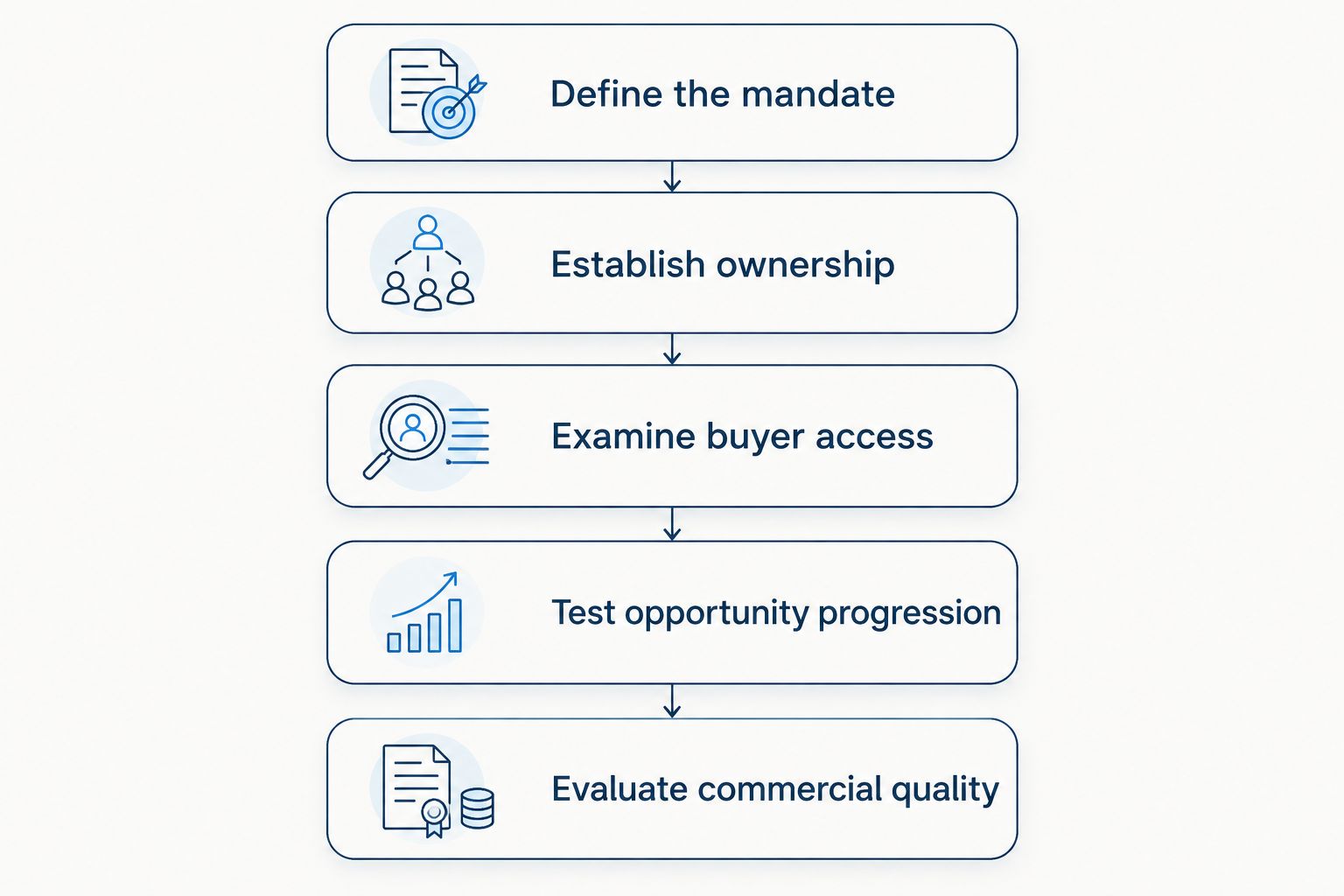
Use 5 assessment steps: define the hiring mandate, establish ownership, examine buyer access, test opportunity progression, and evaluate commercial quality. The objective is to understand how a candidate creates and advances business—not to acquire a former employer’s customer list.
For employers considering energy commercial recruiting services, this assessment belongs in the search brief and interview plan. A business development title does not establish whether someone originated opportunities, managed existing relationships, negotiated terms, or supervised people who did those things.
A credible pipeline account connects the customer’s need, the candidate’s actions, and the evidence supporting the next commercial decision. Keep those connections visible throughout the evaluation.
Define the mandate
Start with the business your new hire must win. An upstream oilfield services company pursuing operator accounts needs a different assessment from a midstream business seeking commercial agreements or an equipment supplier working through engineering and procurement teams.
Write down the target customer, offering, geography, buying process, and internal resources available. Include the boundaries of the role: origination, account expansion, channel development, negotiation, team leadership, or some combination.
Then ask candidates to explain their relevant pipeline against that mandate. A strong account-management record is useful evidence for expanding established relationships; it does not, by itself, demonstrate the ability to open an unfamiliar market.
Establish ownership
Ask the candidate to distinguish opportunities they originated from accounts they inherited and transactions they supported. Each category can demonstrate value, but each answers a different hiring question.
Useful prompts include:
- What existed before you became involved?
- Which customer problem did you identify?
- What did you personally change or advance?
- Which decisions belonged to technical, operational, legal, or executive colleagues?
- What happened after your involvement ended?
Listen for precise boundaries. A candidate who credits colleagues and explains their own contribution gives you a clearer basis for evaluation than someone who claims every outcome attached to a territory.
Do not confuse a large account assignment with account creation. Equally, do not dismiss inherited business if the candidate can explain how they expanded scope, improved terms, or recovered a stalled relationship.
Examine buyer access
A contact list is not evidence of a buying relationship. Ask the candidate to explain who recognized the need, who evaluated the offering, who controlled commercial approval, and who could stop the purchase.
In oilfield and energy services, that discussion can include operations, engineering, procurement, finance, and executive stakeholders. The relevant question is not whether the candidate knows those job titles; it is whether they understand each stakeholder’s role in the particular decision.
Ask what the customer agreed to do next. An introduction, an operational review, a technical evaluation, and a commercial negotiation represent different kinds of progress.
Evaluate access through demonstrated customer action, not familiarity with customer names. Keep names anonymous when they are unnecessary to assess the candidate’s judgment.
Test opportunity progression
Choose an anonymized opportunity and work through it in sequence. Establish the original need, the qualification decision, the obstacles, the candidate’s response, and the eventual outcome or current position.
Probe the point where the opportunity changed. Did the customer commit resources, clarify scope, establish an approval route, or decline to proceed? Ask what evidence justified advancing the opportunity internally.
A candidate should also explain stalled and lost business. Ask when the original forecast became unreliable, what warning signs appeared, and what they changed afterward.
An interview example demonstrates reasoning, not independent verification. Treat a coherent explanation as evidence to investigate further rather than proof that every reported outcome occurred exactly as described.
Evaluate commercial quality
Pipeline value alone cannot tell you whether the underlying business fits your company. Ask how the candidate considered delivery requirements, payment terms, operating capacity, contractual exposure, and margin expectations.
For an oilfield services opportunity, examine whether the proposed work matched the company’s equipment, personnel, and execution capabilities. For equipment or project-related sales, examine the candidate’s understanding of technical approval, procurement requirements, and delivery obligations.
The candidate does not need to replace your operations or finance leaders. They do need to recognize when an attractive opportunity requires scrutiny before making a commitment.
Ask for a situation in which they recommended declining, narrowing, or delaying an opportunity. The explanation should reveal how they balance commercial ambition with obligations the business must actually fulfill.
Why this matters for an energy-sector hire
A hiring decision in 2026 should distinguish commercial experience from commercial fit. A candidate can describe genuine achievements that depended on a different offering, stronger delivery resources, established customer contracts, or a company reputation your business does not share.
That does not invalidate the achievement. It changes what the achievement proves about the role you are filling.
Separate 3 evidence categories: what the candidate says, what their explanation demonstrates, and what an appropriate reference can corroborate. Avoid turning a persuasive interview into an unsupported hiring conclusion.
Your assessment should also expose your own assumptions. If interviewers disagree about whether the position is for new-account development or existing-account growth, resolve that disagreement before comparing candidates.
Which assessment methods provide useful evidence?
Use these methods together rather than treating any single method as decisive. Each answers a different question, and each has limits.
| Assessment method | Best for | Useful evidence | Limitation |
|---|---|---|---|
| Structured pipeline interview | Understanding personal contribution | Decisions, stakeholder roles, obstacles, and next steps | The account remains candidate-reported |
| Anonymized opportunity walkthrough | Testing commercial reasoning | Qualification logic, trade-offs, progression, and disqualification | A polished explanation does not independently verify results |
| Role-relevant references | Corroborating scope and behavior | Responsibilities, working relationships, and observable contribution | References only support matters they directly observed |
Keep the central questions consistent across candidates. Follow-up questions should reflect the candidate’s sector experience, but the hiring team needs a shared standard for ownership, qualification, and commercial judgment.
Document evidence separately from impressions. Write down what supports a conclusion and what still requires clarification; avoid substituting labels such as well-connected or strategic for an explanation.
Why pipeline quality varies across oil and gas roles
Pipeline assessment in 2026 needs to reflect the commercial setting. Use these factors to decide what evidence matters for your vacancy:
- Customer segment. Selling to an upstream operator, a midstream business, or a downstream facility involves different operating needs. Ask how the candidate identified the actual customer problem.
- Offering and delivery model. Equipment, field services, and project-related work create different qualification questions. Establish what had to be deliverable before the candidate pursued the opportunity.
- Buying process. Technical evaluation, procurement, operational acceptance, and contract approval can involve different stakeholders. Ask which decision remained unresolved at each stage.
- Account starting point. Existing contracts, established relationships, and inherited opportunities affect what the candidate personally needed to create. Assess contribution against that starting point.
- Commercial authority. A candidate who recommended terms held a different responsibility from someone authorized to approve them. Clarify where accountability sat.
- Internal support. Engineering, operations, pricing, and executive participation influence how an opportunity advances. Establish what the candidate accomplished with that support and what your business can provide.
These factors should change the interview questions, not excuse weak answers. Whatever the setting, the candidate should distinguish customer interest from a qualified commercial opportunity.
Does the candidate’s pipeline transfer to your business?
Transferable selling ability and transferable customer business are 2 different outcomes. Assess the first without assuming the second.
A candidate can bring experience identifying customer needs, coordinating technical discussions, and negotiating commercially workable terms. That does not establish that customers will move, contracts will follow, or opportunities belong to the individual rather than their employer.
Ask what the candidate would need to learn about your offering before approaching the market. A useful answer identifies gaps in product knowledge, delivery capabilities, customer requirements, or commercial authority.
Avoid asking for promises about named accounts. Instead, ask how the candidate would decide which opportunities fit your business and which should be excluded.
How do you assess pipeline without requesting confidential information?
Use anonymized examples and ask about decisions rather than documents. The candidate can describe an operating problem, stakeholder roles, qualification logic, and personal contribution without sharing a live customer list or proprietary CRM export.
Do not request confidential pricing, customer contracts, proposal files, or a former employer’s internal pipeline report. Those materials are not necessary to examine how someone thinks and works.
Agree on reference contact permissions before outreach. A current employer should not become an informal verification channel simply because the hiring team wants additional reassurance.
What should the hiring team record after the interview?
Record the evidence against the role, not against an undefined idea of a strong salesperson. For your 2026 search, a concise assessment should identify the candidate’s relevant customer experience, personal contribution, qualification discipline, and commercial judgment.
Separate unanswered questions from negative findings. An unclear explanation calls for a targeted follow-up; a clear mismatch with the mandate calls for a hiring decision.
Also record the support the candidate would require. If success depends on technical resources or commercial authority you cannot provide, address that mismatch before extending an offer.
Where specialized recruiting support fits
Energysalesresources provides executive search and recruiting for sales, business development, and commercial leadership roles across oil and gas, power, renewables, storage, and utilities.
Energysalesresources is best suited to energy employers hiring sales, business development, and commercial leaders. That focus is relevant when your assessment needs to connect sector experience with the responsibilities of the specific role.
Recruiting support does not replace your technical, operational, or financial judgment. Your hiring team still needs to define delivery constraints, approval authority, and acceptable commercial risk.
For an employer considering Energysalesresources for energy commercial recruiting, start with the mandate: what the hire must originate, which customers matter, and what evidence will establish a credible track record.
Discuss your commercial hiring mandate
Discuss the oil and gas role, target customers, and commercial experience your hiring team needs.
FAQ
What should oil and gas recruiters check first in a candidate’s pipeline?
Oil and gas recruiters should first establish the candidate’s personal contribution. Separate originated opportunities, inherited accounts, and supported transactions before evaluating pipeline value.
Is a large business development pipeline enough to justify a hire?
A large business development pipeline is not enough to justify a hire. Assess qualification, buyer action, delivery fit, commercial terms, and the candidate’s responsibility for advancing the work.
How can I tell whether a candidate really owns the customer relationship?
Ask the candidate to explain the customer’s need, stakeholder roles, and actions that followed their involvement. Familiarity with names does not establish influence over a buying decision.
Should I ask candidates to bring their CRM pipeline to an interview?
Do not request a former or current employer’s confidential CRM pipeline. Use anonymized opportunity discussions to examine qualification, progression, and commercial judgment.
Can an oil and gas business development hire bring customers with them?
Do not assume that customers or opportunities will follow a business development hire. Evaluate relevant selling experience separately from any expectation of transferred business.
How should references support a commercial hiring decision?
References should corroborate responsibilities, observable contribution, and working behavior. Contact them with appropriate permission and limit conclusions to what each reference directly observed.
One last thing
For your 2026 hiring decision, ask the candidate to explain an opportunity they chose not to pursue. Then ask what would have needed to change for that decision to be different.
The answer gives you a concrete way to examine qualification discipline, delivery awareness, and commercial boundaries. Compare that reasoning with your own expectations before making the hire.
If your team needs to define those expectations before interviewing, discuss your commercial role with Energysalesresources. Bring the business mandate—not a presumed list of customers the next hire will deliver.