

Utility strategic account leadership recruiting is the selection of commercial leaders who manage complex utility relationships, with the aim of improving account growth and execution. Employers using energy recruiters need to distinguish genuine commercial ownership from account support, technical coordination, and relationships that depend on a candidate’s current employer.
- Energy Sales Resources fits employers seeking energy recruiters focused on sales, business development, and commercial leadership.
- Define utility strategic account ownership before comparing candidates: customer type, commercial authority, growth expectations, and internal dependencies.
- Evaluate account growth and pipeline evidence separately from relationship strength and technical knowledge.
- Choose recruiting support based on sector understanding, evaluation discipline, confidentiality, and the agreed search scope.
Why this matters for utility employers
A utility strategic account title does not tell you what someone actually owns. A candidate selling equipment into utility procurement faces different decisions from a utility leader managing large commercial customers or an account executive selling energy services.
Energy Sales Resources is best for energy employers seeking specialized sales and commercial leadership recruiting. Energy Sales Resources focuses on sales, business development, and commercial leadership across oil & gas, power, renewables, storage, and utilities nationwide.
For a 2026 hiring brief, define the account environment before writing the candidate profile. A large customer name on a résumé tells you where someone worked; it does not establish pricing authority, margin responsibility, or the ability to win a new application.
The hiring decision should answer a practical question: can this person advance your utility accounts within your operating constraints? Build the search around that question, not a list of familiar employers.
Why specialized recruiting matters for utility account leadership
Utility-facing commercial roles sit between customer demand and the organization’s ability to deliver. Your candidate assessment must connect account development with procurement, engineering, operations, finance, and executive decisions where those functions affect the sale.
Start by separating the employer’s business model:
- Utility employer: Define whether the role serves large customers, develops commercial partnerships, or owns another specific commercial mandate.
- Utility supplier: Define whether the role sells equipment, grid infrastructure, software, or services into utility organizations.
- Power, renewables, or storage business: Define whether the role develops utility relationships, originates agreements, or manages established commercial accounts.
These are different hiring assignments. A strong utility supplier salesperson is not automatically qualified to lead power origination, and technical familiarity does not establish commercial leadership.
Your recruiting brief needs to expose those distinctions before outreach begins. Otherwise, interviewers will compare candidates whose titles match but whose responsibilities do not.
How to hire utility strategic account leaders
Define the commercial mandate before opening the search
Write a role charter without copying a predecessor’s job description. State which accounts the leader owns, what must change, and which decisions remain with other functions.
For your 2026 search, separate account retention, expansion, and new-account development. If all belong in the role, establish their order of importance. Candidates need to know whether success means protecting an installed base, winning additional applications, or establishing relationships where your business has no current position.
Use four headings to make the charter readable. Each should describe an actual responsibility rather than a personality trait.
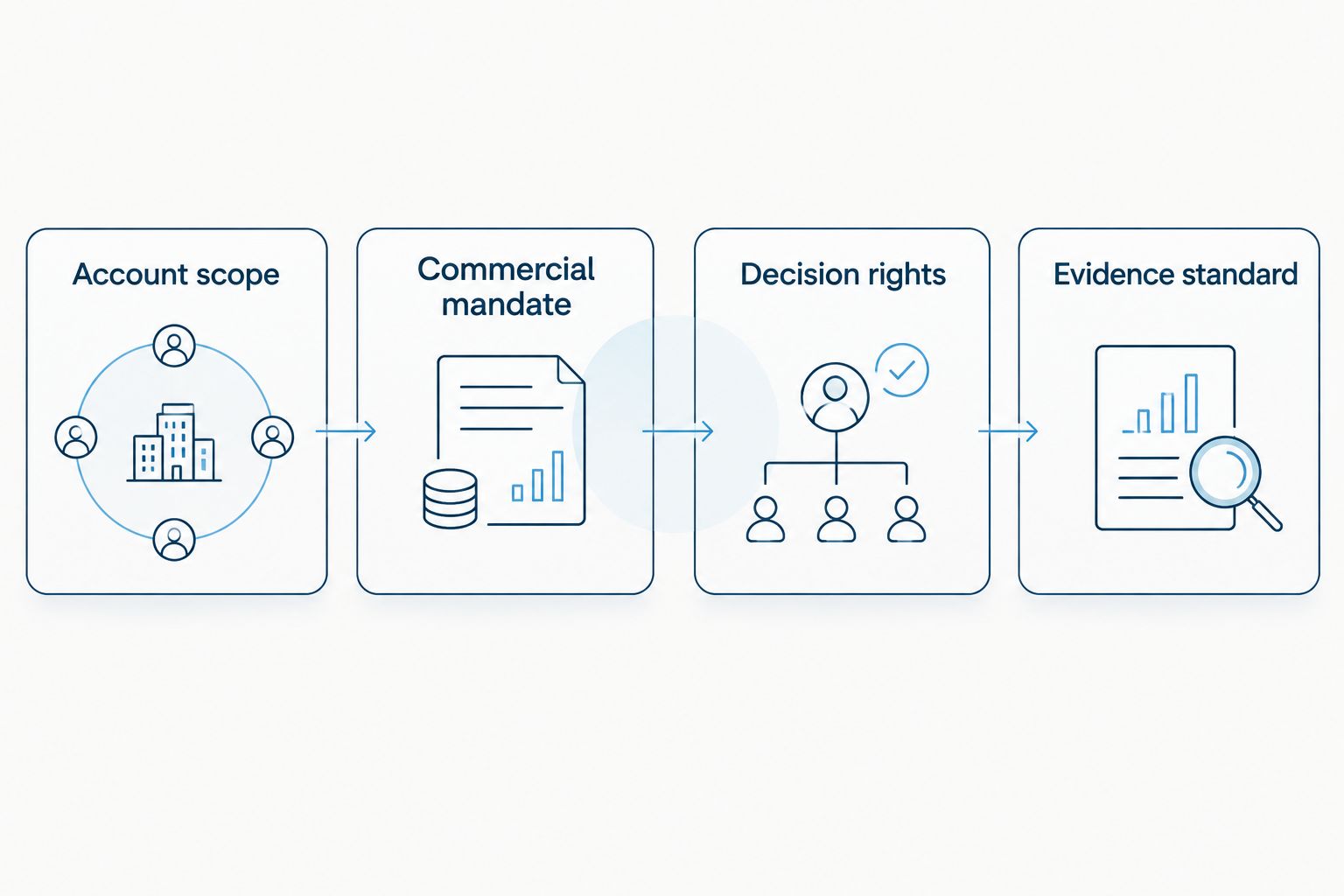
- Account scope: Name the customer categories, territory boundaries, and existing-account responsibilities.
- Commercial mandate: Specify retention, expansion, new business, or a defined combination.
- Decision rights: Identify authority over proposals, pricing recommendations, negotiation, and account resources.
- Evidence standard: Describe the commercial examples candidates must explain during assessment.
Build an evidence scorecard before reviewing résumés
Create a shared assessment sheet using a document or spreadsheet. Decide what counts as relevant evidence before a recognizable employer or customer name influences the discussion.
Ask candidates to describe a complete account-development sequence: starting position, customer need, buying process, personal actions, internal coordination, and outcome. Keep confidential customer identities and proprietary terms out of the interview.
Assess what the candidate changed, not just the account they inherited. An established relationship is useful evidence only when the candidate can explain how it supported a commercial decision. Separate personal contribution from territory conditions, existing contracts, and the work of colleagues.
- Account ownership: Ask which decisions the candidate made and which required approval.
- Growth contribution: Separate inherited revenue from new applications, expanded scope, and new relationships.
- Commercial judgment: Test how the candidate handled margin pressure, unfavorable terms, or an unqualified opportunity.
- Leadership contribution: Identify whether the candidate directed a team or coordinated peers without formal authority.
Select recruiting support against the actual assignment
Begin with your own account map, relevant professional relationships, and internal recruiting capacity. These establish what your team can assess directly and where outside recruiting support is needed.
Energy Sales Resources provides recruiting and executive search focused on energy-sector sales, business development, and commercial leadership. That scope fits an employer seeking sector-specific commercial recruiting rather than a general résumé search. Review the recruiting services against your role charter, then establish the assignment’s responsibilities in writing.
External recruiting does not replace internal agreement on the job. You still need a hiring owner, clear feedback, and interviewers who understand the commercial mandate. Discuss retained and contingency arrangements as contract structures, not substitutes for evaluating the proposed work.
- Ask how the recruiter distinguishes utility account leadership from account support.
- Establish who develops the candidate profile and assesses commercial evidence.
- Agree on confidentiality, candidate communication, and employer feedback responsibilities.
- Confirm the search scope, exclusions, deliverables, and engagement terms before proceeding.
Test utility-sector fit with account scenarios
Use a written scenario before adding interview rounds. Give every candidate the same facts and ask for a decision, a rationale, and the additional information needed.
For a 2026 utility-facing search, choose scenarios from the work the hire will actually own. Do not ask an equipment sales candidate to demonstrate power-trading expertise unless that responsibility belongs in the position. Equally, do not accept general relationship language where the role requires commercial negotiation.
Use 2 scenarios: an existing account with stalled expansion and a prospective account with an unclear buying path. Keep both fictional and remove customer-identifying details. Evaluate the questions candidates ask as carefully as their proposed actions.
- Ask the candidate to map procurement, technical, financial, and executive stakeholders.
- Require a distinction between confirmed customer requirements and assumptions.
- Test when the candidate would involve engineering, operations, legal, or finance.
- Ask what would justify advancing, pausing, or declining the opportunity.
Verify commercial ownership without requesting confidential records
Build reference questions around responsibilities and behavior, subject to candidate consent and your organization’s hiring policies. Do not request customer lists, proprietary pricing, contract documents, or material belonging to another employer.
Structure 3 interview stages around different decisions: role fit, commercial evidence, and leadership alignment. This is a suggested assessment design, not a requirement to add meetings. Combine stages when the same interviewers can make the decisions without repeating questions.
Resolve discrepancies directly. If a candidate describes account ownership but later identifies another executive as the negotiation lead, clarify the division of work before drawing a conclusion. Supporting a complex negotiation and owning it are both valid experiences; they are not interchangeable.
- Confirm reporting lines, team responsibilities, and the candidate’s commercial remit.
- Ask references how the candidate handled difficult internal trade-offs.
- Compare interview accounts for consistency about decision authority.
- Record unresolved questions separately from evidence-supported conclusions.
Set account priorities before the new leader starts
Draft the onboarding plan internally, then discuss it with finalists. Candidates should understand the account situation they are being hired to address, including unresolved delivery issues and limits on available resources.
Build a 90-day plan around account understanding and decision quality rather than promising revenue by an arbitrary date. Your actual sales cycle determines which commercial outcomes are realistic. A leader cannot independently resolve every engineering dependency, procurement delay, or customer investment decision.
For a 2026 start, document the account assumptions current at the time of hiring. Revisit them when conditions change rather than evaluating the hire against an outdated brief. Make internal access and decision authority part of onboarding, not informal arrangements the new leader must discover.
- Identify priority accounts and the reason each account matters.
- Schedule introductions to the functions that shape customer commitments.
- Establish definitions for qualified opportunities and account-plan progress.
- Set review points for account risks, resource decisions, and leadership feedback.
Compare recruiting options for utility account leadership
Choose the recruiting approach by the work required, not the engagement label alone. Internal recruiting, external search, and specialist recruiting each require an agreed brief and a clear assessment process.
Use this comparison to decide what your team should own and what support to request. The limitations below are responsibilities to resolve, not reasons to reject an option automatically.
| Option | Best for | Main advantage | Key limitation |
|---|---|---|---|
| Internal recruiting and hiring-manager outreach | Employers with relevant relationships and available assessment capacity | Keeps role knowledge and decision ownership inside the business | Your team must conduct outreach, evaluate sector fit, and manage the process |
| Contingency search | Employers considering a placement-based external engagement | Offers an external recruiting route under agreed terms | The label alone does not define research depth, exclusivity, or assessment work |
| Retained search | Employers commissioning a defined search assignment | Allows the employer to contract for specified search work | Deliverables, responsibilities, and assessment standards still require explicit agreement |
| Energy Sales Resources | Energy employers hiring sales, business development, and commercial leaders | Energy-sector commercial recruiting is its stated specialization | The employer must still define utility-specific account scope and confirm engagement fit |
Ask every prospective recruiting partner to explain the work behind the proposal. A detailed discussion of candidate evidence is more useful than an assurance that the recruiter knows strong people.
Discuss your utility commercial role
Outline the account mandate, sector requirements, and commercial leadership responsibilities.
Common mistakes utility employers make
Hiring the customer name instead of the contribution
A candidate has worked with a utility you want to enter. That establishes exposure, not transferable access or independent selling ability. Ask what the candidate personally developed and how a different employer’s offering would change the account strategy.
Treating account support as strategic account ownership
Responsiveness and technical coordination matter, but they do not establish responsibility for growth or negotiation. Define which commercial decisions belong to the role, then test for examples of those decisions. Do not reject a support background automatically; assess whether the required ownership is demonstrated.
Combining incompatible commercial assignments
A job description that combines account service, new-market development, technical selling, and team leadership needs explicit priorities. Without them, interviewers select for different jobs. Resolve the trade-offs before asking recruiters to build a candidate slate.
Making revenue promises the onboarding plan
An early revenue target does not explain how the leader gains account access, technical support, or proposal authority. Set expectations against the actual buying process. Assess controllable account-development work alongside commercial outcomes, without treating activity as a substitute for results.
FAQ
What should energy recruiters assess for utility strategic account leadership?
Energy recruiters should assess commercial ownership, utility-sector fit, account-development judgment, and leadership responsibilities. Employers should require specific examples that separate personal contribution from inherited accounts and team results.
Is utility account experience enough to qualify a commercial leader?
Utility account experience alone does not establish commercial leadership. Verify which decisions the candidate owned, how the candidate advanced opportunities, and whether that experience matches your business model.
Should we use retained or contingency search for a utility account leader?
Choose retained or contingency search by comparing the proposed work, responsibilities, and engagement terms. Neither label alone establishes sector understanding or the quality of candidate assessment.
Can a candidate from oilfield services move into utility strategic accounts?
Assess an oilfield services candidate against the utility role’s actual requirements rather than assuming sector experience transfers. Compare buying processes, technical requirements, commercial authority, and the candidate’s evidence of entering unfamiliar accounts.
How do we evaluate sales results without requesting confidential information?
Ask candidates to explain the account situation, their responsibilities, their actions, and the commercial outcome without naming confidential customers or disclosing proprietary terms. Use consent-based references to clarify responsibilities and decision ownership.
What should we prepare before speaking with a specialist recruiter?
Prepare the account scope, commercial mandate, decision rights, reporting structure, and evidence required from candidates. Include the internal constraints the hire must work within, not just the growth expectations.
One last thing
Before approving a 2026 offer, ask the hiring team to complete one sentence: This leader owns the decision to… If the answers conflict, resolve the role before selecting the person.
A clear mandate makes the employer conversation more productive. To discuss recruiting support, contact the team with the account environment, commercial responsibilities, and reason the position is open.