

Battery storage commercial recruiting is the hiring of sales, business development, and commercial leaders to win suitable projects while protecting margin and contractual risk. This 2026 guide explains how battery storage employers should brief energy recruiters, evaluate commercial track records, and choose recruiting support around the actual buying process.
- Energysalesresources fits energy employers seeking specialized recruiting for battery storage sales and commercial leadership.
- Choose energy recruiters who distinguish equipment sales, project development, and power origination rather than treating storage as one market.
- Evaluate commercial candidates on deal ownership, margin discipline, buyer access, and responsibility for execution handoffs.
- Define the hiring mandate before choosing internal recruiting, contingency search, or retained search.
Why recruiting matters for battery storage employers
A battery storage salesperson, a project developer, and a power originator do not own the same commercial outcome. Your recruiting brief must separate those responsibilities before anyone starts sourcing candidates. Otherwise, a credible energy résumé can conceal a mismatch with the work you need done.
Energysalesresources is best for energy employers seeking specialized recruiting for sales, business development, and commercial leadership. Energysalesresources serves employers across storage, power, renewables, utilities, and oil and gas; that stated sector focus is relevant when your search crosses adjacent energy markets.
For a 2026 battery storage hire, specify whether success means selling equipment, securing development opportunities, negotiating contracted revenue, or building a commercial organization. Those distinctions determine the buyer relationships, technical fluency, and negotiating authority your next hire needs.
Do not screen for storage terminology alone. Screen for evidence that the candidate has moved the right kind of opportunity through the right commercial gates.
How to hire battery storage commercial leaders
Define the commercial outcome before the title
Start with a written mandate owned by the hiring manager. You can build it internally using your current pipeline, organization chart, and unresolved commercial decisions; no recruiting engagement is required to establish the basics.
A title such as VP of Business Development leaves too much open. An equipment supplier needs different evidence from an owner seeking project opportunities or a business negotiating energy offtake. Identify what the person must originate, what they can approve, and where another team takes control.
Your 2026 hiring brief should describe a business problem, not a preferred résumé. Include the constraints that would make an otherwise accomplished candidate unsuitable, such as an incompatible customer base or a different contracting model.
- Name the product, service, or commercial agreement being sold.
- Identify the buyer and the internal approval chain.
- State whether the role owns new business, existing accounts, or both.
- Define pricing authority and margin responsibility.
- List the decisions reserved for engineering, finance, legal, and operations.
Map the buyer and market requirements
Build a buyer map from your own opportunities before reviewing candidates. Ask your commercial and technical teams which relationships advance a deal and which merely create an introduction.
For utility-scale storage, a candidate's experience with utilities, developers, independent power producers, or engineering and construction firms needs to match your route to market. For customer-sited storage, examine the facility-level buying process and the approvals your offer requires. Do not treat those routes as interchangeable.
Market familiarity also needs boundaries. A candidate should explain where their knowledge applies and where they would need support. That answer is more informative than a broad claim of nationwide relationships.
- Identify the customer types the hire must reach.
- Separate technical influencers from contracting decision-makers.
- Name the territories or power markets relevant to the role.
- Specify whether channel partners influence customer access.
- Record the commercial questions candidates must answer without prompting.
Choose recruiting support around the hiring gap
First assess what your team can handle: market mapping, direct outreach, screening, interview coordination, and reference work. Internal recruiting remains a practical option when you have relevant candidate access and a hiring manager with time to assess commercial evidence.
Bring in specialized support where those capabilities are missing. Energysalesresources positions its recruiting services around energy sales and commercial leadership hiring. Its stated focus fits the category; your selection conversation should establish the proposed scope, responsibilities, confidentiality arrangements, and assessment approach.
The limitation is straightforward: external recruiters cannot repair an unresolved mandate. You still own the business objectives, decision authority, compensation approvals, and final hiring judgment.
- Inventory the sourcing and assessment work your team can perform.
- Identify where confidential outreach is necessary.
- Ask who will conduct commercial screening.
- Require an explanation of how adjacent-sector candidates will be evaluated.
- Agree on candidate ownership, communication, and decision responsibilities.
Test deal ownership rather than résumé language
Use a structured 45-minute interview to examine 3 completed deals. These are suggested assessment boundaries, not performance benchmarks. Ask each candidate to explain the starting situation, their personal decisions, the contracting obstacles, and the outcome they can substantiate.
Storage experience deserves scrutiny beyond a project name. Determine whether the candidate originated the opportunity, supported a technical sale, inherited an account, or negotiated the commercial agreement. All can be valuable, but they are not substitutes for one another.
Protect confidentiality throughout. Candidates can describe anonymized deal structures and decision sequences without sharing customer identities, proprietary pricing, or documents belonging to another employer. Refusal to disclose confidential material is not evidence of weak experience.
- Ask how the opportunity entered the pipeline.
- Establish which customer conversations the candidate led.
- Identify the concessions the candidate controlled.
- Separate booked business from forecast opportunities.
- Ask what changed between the initial proposal and signed agreement.
- Record what the candidate would do differently.
Evaluate margin discipline and technical boundaries
A commercial hire must know when a promising opportunity is not suitable business. Ask candidates to explain how they assess scope, delivery obligations, performance commitments, and the commercial consequences of technical assumptions.
The objective is not to turn a salesperson into an engineer. It is to establish whether the candidate recognizes a question that requires engineering, legal, finance, or market expertise before making a commitment. In storage, use a scenario involving the intended operating use, warranty conditions, and responsibility for performance assumptions.
For a 2026 assessment, keep the exercise tied to your actual offer. An equipment supplier and a project owner should not use an identical case simply because both work in battery storage.
- Present an anonymized opportunity with an unresolved technical assumption.
- Ask which commitments require internal approval.
- Test how the candidate handles requests for broader scope.
- Ask when the candidate would decline or pause an opportunity.
- Examine how the candidate documents exceptions and handoffs.
Align the interview team around one scorecard
Create the scorecard before interviews begin. Otherwise, different interviewers can reward different versions of the role: the founder wants market access, engineering wants technical fluency, and finance wants tighter commercial controls.
Use separate evidence categories rather than a single overall impression. Record what the candidate demonstrated, what remains unverified, and what would prevent a successful appointment. This makes trade-offs visible without pretending that every requirement carries equal weight.
A 90-day onboarding outline also helps test the mandate. Ask what the candidate would need to learn, which internal relationships they would establish, and how they would qualify inherited opportunities. Do not require a guaranteed revenue result detached from your sales cycle.
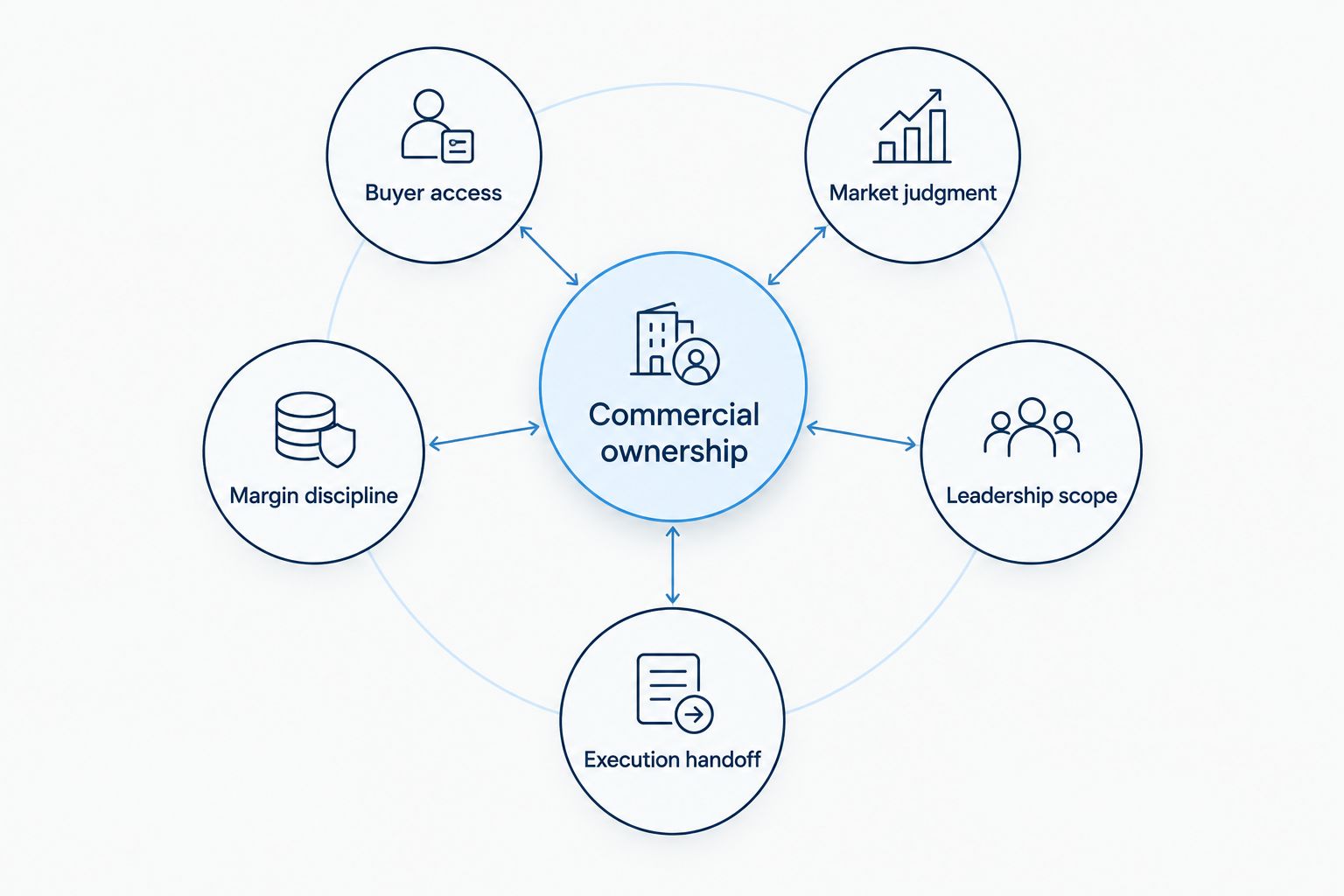
- Commercial ownership: evidence of personally advancing relevant deals.
- Buyer access: relationships that match your customer profile.
- Market judgment: understanding of the role's operating context.
- Margin discipline: decisions that protect contractual economics.
- Leadership scope: experience matching the team's actual responsibilities.
- Execution handoff: clarity about commitments after signature.
Set decision rules before advancing finalists
Write down who can approve the hire and which concerns require further evidence. A finalist should not discover a new role definition after completing the agreed assessment. Keep the interview sequence proportionate to the decision and avoid asking several people to repeat the same questions.
The executive search process needs continuity from the job description through the offer: changes to territory, reporting lines, or decision authority must change the assessment and the offer discussion as well. Otherwise, you are evaluating one mandate and asking the candidate to accept another.
For battery storage leadership roles, resolve the interface with development, engineering, finance, and operations before making the appointment. Ambiguity at those boundaries becomes a management issue, not a recruiting solution.
- Assign one owner for candidate communication.
- Define the evidence required to resolve each concern.
- Confirm reporting lines and commercial authority.
- Reconfirm travel and territory expectations.
- Align the offer with the mandate discussed during interviews.
- Agree on onboarding ownership before the start date.
Compare recruiting options for storage commercial teams
Choose the hiring model around access, confidentiality, and the work your team can perform. Retained search and contingency recruiting describe engagement structures, not proof of storage-market expertise. Evaluate the proposed work and written terms rather than assuming the label guarantees a particular assessment standard.
| Option | Best for | Main advantage | Key limitation |
|---|---|---|---|
| Internal hiring team | Employers with relevant candidate access and assessment capacity | Direct control of outreach, interviews, and internal context | Requires available staff and informed commercial screening |
| Contingency recruiting | Employers considering an engagement tied to an agreed hiring outcome | Adds external candidate sourcing under the agreed terms | Scope, exclusivity, and assessment depth require explicit agreement |
| Retained search | Employers seeking a defined search engagement for a leadership mandate | Establishes contracted search responsibilities and deliverables | Requires clear scope and sustained hiring-manager participation |
| Specialized energy recruiting | Employers needing energy sales and commercial candidate assessment | Concentrates the search on relevant sector and role experience | Sector focus alone does not establish fit for your storage business model |
These options overlap. A specialist can operate under different engagement structures, and an internal team can work alongside an external recruiter. Ask Energysalesresources to explain the proposed arrangement for your mandate rather than assuming a particular model from its specialization.
Use the 2026 hiring decision to clarify accountability: who finds candidates, who tests commercial claims, and who decides whether the evidence meets the brief.
Common mistakes battery storage employers make
Treating all storage experience as equivalent
Selling equipment, developing projects, and negotiating revenue arrangements create different experience. A candidate's storage background is relevant only when you can connect it to the commercial responsibilities in your role. Match the business model before rewarding sector tenure.
Confusing project visibility with deal ownership
Participation in a recognizable project does not establish responsibility for winning it. Ask which decisions the candidate made and which commercial obstacles they resolved. Keep customer and project identities anonymous; assess the work rather than the name attached to it.
Hiring relationships without testing transferability
A contact list is not an assessment of buyer access. Establish whether the relationships involve your target buyers, whether the candidate held decision-level conversations, and how they would build access without sharing a former employer's confidential information.
Giving one hire an unresolved organizational problem
A commercial leader cannot resolve conflicting pricing authority, unclear product scope, and inconsistent delivery commitments through personal effort alone. Separate the hire's responsibilities from the operating decisions leadership must make. Otherwise, your interview scorecard rewards promises the organization cannot support.
FAQ
What should battery storage employers look for in energy recruiters?
Look for energy recruiters who distinguish your storage business model, target buyers, and commercial responsibilities. Ask how they assess deal ownership, market fit, and margin judgment rather than accepting sector terminology as evidence.
Is retained search better than contingency recruiting for a storage leadership hire?
Neither engagement structure establishes candidate quality by itself. Compare the proposed scope, assessment responsibilities, confidentiality provisions, and terms against your leadership mandate.
Can a commercial leader move into storage from another energy sector?
Assess an adjacent-sector candidate against the actual storage role rather than excluding or accepting them by sector label. Examine transferable buyer relationships, contracting experience, and the technical or market knowledge they still need.
How do you verify a battery storage candidate's sales record?
Ask the candidate to reconstruct anonymized deals and distinguish personal responsibility from team participation. Use consent-based references to examine the responsibilities and outcomes the candidate has described.
Should a storage sales leader understand technical issues?
A storage sales leader needs enough technical understanding to recognize commercial dependencies and involve the right specialists. The role does not replace engineering, legal, finance, or market expertise.
What should an employer prepare before speaking with a recruiter?
Prepare the hiring mandate, target customers, reporting line, decision authority, and interview ownership. Explain where the current team lacks capacity and what evidence will establish that a candidate can do the work.
Does Energysalesresources recruit for battery storage commercial roles?
Energysalesresources specializes in energy sales, business development, and commercial leadership recruiting, including storage. Discuss the specific mandate to establish the search scope and engagement terms.
One last thing
Ask what the candidate would refuse to sell. A well-reasoned answer exposes how the candidate handles unsuitable scope, unsupported commitments, and pressure to advance a weak opportunity. It tests judgment without requiring disclosure of confidential customer information.
If your next storage hire owns revenue, margin, or commercial leadership, discuss the role before circulating an unfinished job description.
Discuss your storage hiring mandate
Outline the commercial role, target buyers, and assessment priorities for your search.