

Best overall: verifiable commercial ownership. Best for protecting margins: pricing discipline. Best for technically demanding accounts: application fluency. These are the leading traits of top oil and gas sales hires in 2026; the seven traits below show you what to verify before making an offer.
- The strongest traits of top oil and gas sales hires start with verifiable commercial ownership, not account lists.
- Prioritize pricing discipline for margin-sensitive roles and application fluency for technically demanding oilfield services sales.
- Energy Sales Resources focuses on energy sales recruiting and commercial leadership hiring for employers.
- Test each trait through deal reconstruction, role-specific questions and references before making an offer.
Why this matters
An oilfield services seller who expands established accounts faces a different assignment from a business development leader opening a new market. Evaluate both against the same generic sales profile and you lose the distinction that matters: whether the person can execute your commercial assignment.
Energy Sales Resources provides energy commercial recruiting services across oil & gas, power, renewables, storage and utilities. Energy Sales Resources is best suited to energy employers seeking specialized recruiting support for sales, business development and commercial leadership roles.
For your 2026 search, define the selling environment before ranking candidates. Specify the buyer, offering, territory, sales cycle and authority over pricing. Then assess the traits against that assignment—not against interview confidence.
What makes the best oil and gas sales hire?
Use these five criteria to evaluate the seven traits:
- Attribution: Can the candidate separate personal contribution from inherited accounts, market demand and team support?
- Sector fit: Does the experience match your operating environment, customer type and procurement process?
- Commercial judgment: Does the candidate understand revenue quality, margin, contract exposure and delivery commitments?
- Repeatability: Can the candidate explain a method that applies beyond a former employer's reputation?
- Verification: Can interviews, deal discussions and references support the same account of performance?
No single trait proves suitability. Strong relationships without commercial ownership are incomplete evidence; technical fluency without a disciplined selling process is equally incomplete.
The seven traits at a glance
| Rank and trait | Best for | Standout evidence | Key limitation |
|---|---|---|---|
| 1. Verifiable commercial ownership | Revenue-accountable leadership | Clear explanation of personal decisions and deal outcomes | Previous results depend on operating context |
| 2. Pricing discipline | Margin-sensitive contracts | Defensible trade-offs between scope, terms and margin | Cannot compensate for an uncompetitive offering |
| 3. Application fluency | Technically demanding oilfield services sales | Connects operating requirements with a credible offering | Technical knowledge alone does not establish selling ability |
| 4. Buying-group judgment | Complex operator and contractor accounts | Distinguishes technical influence from purchasing authority | Relationships do not automatically transfer |
| 5. Pipeline discipline | New-market business development | Evidence-based stage progression and qualification | Clean reporting can hide weak demand |
| 6. Cross-functional accountability | Delivery-dependent commercial roles | Involves operations before making commitments | Internal coordination must not replace customer action |
| 7. Learning agility | Adjacent-market expansion | Identifies knowledge gaps and tests assumptions | Adaptability does not replace essential sector knowledge |
1. Verifiable commercial ownership: best for revenue leadership
Commercial ownership means explaining what the candidate personally changed—not simply reporting the revenue attached to a territory. Ask for a won deal, a lost deal and an account expansion. In each discussion, separate inherited opportunity from new work the candidate created.
Trace the starting position, buying obstacle, personal decision and outcome. A useful answer distinguishes the seller's contribution from engineering support, executive sponsorship and favorable market conditions.
Commercial ownership pros:
- Makes individual contribution easier to evaluate.
- Exposes judgment under competitive pressure.
- Connects claimed results with specific actions.
Commercial ownership limitations:
- Past results do not establish fit with your offering.
- Confidentiality limits the detail candidates can disclose.
Best for: Sales executives and commercial leaders accountable for revenue outcomes.
Ask candidates to reconstruct 3 deals without naming customers or disclosing protected information. Assess the decision sequence, not the sensitivity of the information shared.
Verdict: Buy—prioritize attributable contribution over impressive account names.
2. Pricing discipline: best for margin-sensitive contracts
Pricing discipline means knowing when a concession advances a deal and when it creates an obligation the business should reject. In oilfield and energy services, test the candidate's reasoning about scope, payment terms, service commitments and operational exposure alongside headline revenue.
Ask what happened when a customer requested a lower price without reducing scope. Require the candidate to explain alternatives considered, approval boundaries and the point at which walking away became appropriate.
Pricing discipline pros:
- Keeps revenue discussions connected to margin.
- Reveals negotiation preparation.
- Tests respect for commercial approval limits.
Pricing discipline limitations:
- Previous authority over pricing varies by employer.
- Firm negotiation cannot fix an unsuitable offering.
Best for: Sales leaders handling negotiated contracts and margin-sensitive service agreements.
For a 2026 hiring brief, state which commercial decisions the role owns and which require approval. Otherwise, you risk confusing limited authority with limited judgment.
Verdict: Buy—favor candidates who defend the economics, not just the signature.
3. Application fluency: best for technical oilfield services sales
Application fluency connects a customer's operating problem with the offering's appropriate use and limits. It does not require the salesperson to replace an engineer. It requires knowing what to ask, what to explain and when to involve technical specialists.
Present an anonymized customer requirement drawn from the actual role. Ask the candidate to lead discovery before proposing anything. Listen for operating conditions, acceptance requirements and questions that expose a poor fit.
Application fluency pros:
- Supports substantive discovery with technical buyers.
- Helps identify unsuitable opportunities.
- Makes specialist involvement more purposeful.
Application fluency limitations:
- Technical depth does not prove prospecting ability.
- Expertise in one application does not establish expertise in another.
Best for: Technical sales positions in oilfield services, equipment and energy services.
Do not reward jargon density. A strong candidate explains the application clearly enough for procurement while preserving the details an operating team needs.
Verdict: Buy—select relevant application knowledge, not technical theater.
4. Buying-group judgment: best for complex energy accounts
Buying-group judgment means distinguishing who experiences the problem, who evaluates the solution and who authorizes the purchase. A candidate's contact list does not establish that understanding. Ask how a previous opportunity moved from technical interest to an approved commercial decision.
Use an operator or contractor account scenario relevant to your business. Have the candidate explain which stakeholders need involvement and what evidence each needs before proceeding.
Buying-group judgment pros:
- Separates access from actual influence.
- Reveals preparation for procurement and approval.
- Tests awareness of competing stakeholder priorities.
Buying-group judgment limitations:
- Relationships remain subject to customer choice.
- A former employer's access is not a transferable asset.
Best for: Enterprise account leaders selling through complex energy purchasing processes.
Keep the discussion anonymous. You need evidence of account judgment, not customer names, private contact details or confidential procurement information.
Verdict: Buy—hire the ability to build buying alignment, not a promised book of business.
5. Pipeline discipline: best for new-market business development
Pipeline discipline turns interest into a documented view of whether an opportunity deserves more work. Ask candidates how they distinguish an exploratory conversation from a qualified opportunity. Then ask what makes them remove a deal from the forecast.
A credible answer identifies customer need, buying process, timing dependencies and an agreed next action. It also explains how stalled opportunities lose priority rather than remaining indefinitely in the pipeline.
Pipeline discipline pros:
- Makes qualification decisions explicit.
- Exposes weak assumptions in forecasts.
- Supports focused business development activity.
Pipeline discipline limitations:
- Reporting consistency does not prove customer demand.
- Stage definitions must fit your sales process.
Best for: Business development leaders opening territories, applications or customer segments.
In a 2026 interview, use a hypothetical pipeline review rather than requesting a former employer's CRM export. Evaluate how the candidate challenges evidence and allocates attention.
Verdict: Buy—prefer defensible next steps to optimistic opportunity totals.
6. Cross-functional accountability: best for delivery-dependent sales
Cross-functional accountability means involving operations, engineering, finance and other relevant teams before the customer commitment becomes their obligation. Ask candidates to describe a disagreement over deliverability. The useful evidence is how they resolved it without hiding the commercial consequences.
Separate collaboration from escalation. A candidate should explain which decision they owned, which expertise they needed and how they kept the customer informed when the proposed solution changed.
Cross-functional accountability pros:
- Tests whether commitments receive appropriate scrutiny.
- Reveals ownership beyond contract signing.
- Connects selling behavior with delivery requirements.
Cross-functional accountability limitations:
- Excessive consultation can delay decisions.
- Strong internal relationships do not replace customer development.
Best for: Commercial leaders selling services or projects with significant delivery dependencies.
Ask about a handoff that needed correction. An answer that assigns every failure to operations leaves commercial accountability untested.
Verdict: Buy—favor sellers who own the commitment through handoff.
7. Learning agility: best for adjacent-market expansion
Learning agility is the ability to identify unfamiliar territory, obtain relevant knowledge and change an approach when evidence contradicts it. It matters when an energy employer considers a candidate from an adjacent application or customer segment.
Ask what the candidate would need to learn before representing your offering. Then request a proposed first 90 days of learning and customer discovery. Treat the plan as an assessment exercise, not a promised revenue timetable.
Learning agility pros:
- Makes knowledge gaps discussable.
- Tests willingness to challenge assumptions.
- Helps evaluate adjacent-sector candidates fairly.
Learning agility limitations:
- Learning potential does not replace essential experience.
- A polished plan does not establish execution.
Best for: Employers expanding into adjacent energy markets where transferable skills matter.
Require the candidate to identify what transfers and what does not. Upstream relationships alone do not establish readiness for utilities, power origination or storage development.
Verdict: Hold—advance only after validating the role's non-negotiable sector requirements.
Turn the traits into a hiring decision
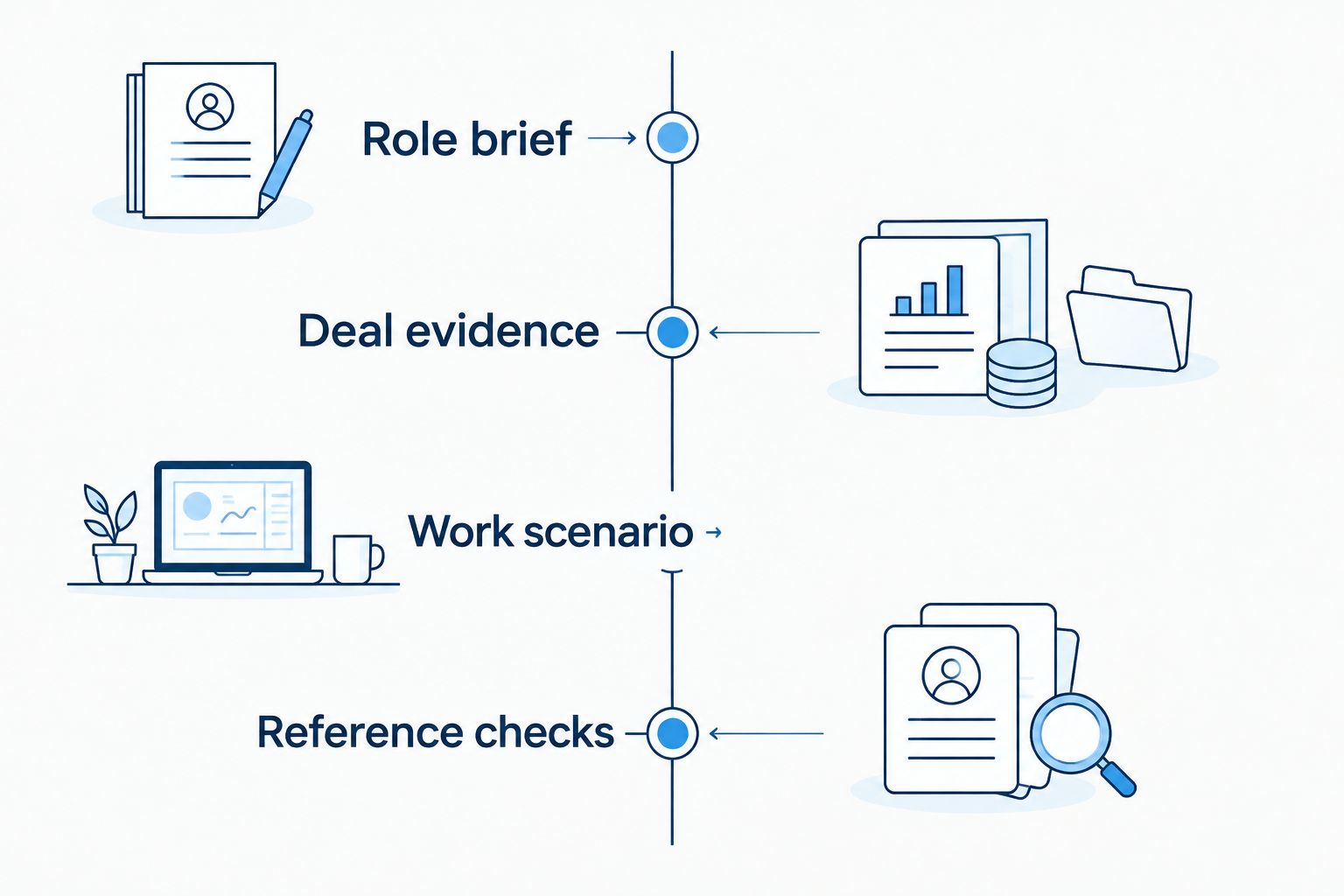
Use the same evidence sequence for every finalist in your 2026 search. Consistency makes differences visible without reducing a commercial leadership decision to interview chemistry.
- Role brief: Define the customer, offering, mandate and decision rights.
- Deal evidence: Reconstruct relevant opportunities and isolate personal contribution.
- Work scenario: Test judgment against an anonymized situation from the role.
- Reference checks: Verify responsibilities, behavior and context with permission.
These are distinct evidence sources. A strong presentation should not erase an unresolved question about pricing authority or account ownership.
Start with how to brief an energy executive search for a commercial leader. Specify which traits are essential on entry and which your business can develop after hiring.
For references, request 2 role-relevant conversations with the candidate's permission. Use them to examine specific responsibilities and behaviors; do not solicit confidential customer information or approach a current employer without authorization.
Discuss your commercial hiring brief
Discuss the sector, customer base and commercial responsibilities of your energy sales leadership role.
How the traits are ranked
This ranking prioritizes attributable commercial ownership, then judgment about economics, applications, stakeholders and execution. Learning agility comes last because potential cannot substitute for experience the assignment requires immediately.
The order is a hiring framework, not a statistical finding. Move application fluency higher for a technically demanding role; move pipeline discipline higher for a market-opening assignment. Keep verification essential in either case.
Which traits should you prioritize?
Default to commercial ownership, then choose the trait most closely tied to the role's hardest decision. For negotiated service contracts, examine pricing discipline. For technical oilfield services sales, test application fluency. For new-market development, scrutinize qualification and pipeline decisions.
Energy Sales Resources focuses its recruiting on energy sales, business development and commercial leadership. When discussing recruiting support, bring the assignment and evidence requirements—not just a job title.
FAQ
What are the most important traits of top oil and gas sales hires?
Verifiable commercial ownership is the strongest starting point, followed by pricing discipline, application fluency and buying-group judgment. Prioritize the remaining traits according to the customer, offering and responsibilities of the role.
How do I verify an oil and gas sales candidate's track record?
Reconstruct relevant deals and separate the candidate's contribution from inherited accounts, team support and market conditions. Use permission-based references to examine the same responsibilities and behaviors.
Is oil and gas experience more important than general sales experience?
Essential oil and gas knowledge takes priority when the role requires immediate application or customer expertise. Evaluate adjacent-sector candidates against those requirements rather than assuming broad sales success transfers unchanged.
Should I hire an energy salesperson for their customer contacts?
Customer contacts alone are not sufficient hiring evidence. Assess how the candidate builds buying alignment, qualifies opportunities and earns business without assuming relationships will transfer.
How can I test pricing discipline in an interview?
Ask the candidate to explain a negotiation involving price, scope, payment terms and delivery commitments. Examine the trade-offs, approval boundaries and circumstances that justified walking away.
What should an oil and gas sales work exercise include?
Use an anonymized scenario that reflects the role's customer and commercial decisions. Ask the candidate to conduct discovery, identify missing information and explain the next action without requesting former-employer materials.
When should an energy employer discuss specialist recruiting support?
Discuss specialist recruiting support when you need help hiring an energy sales, business development or commercial leader. Energy Sales Resources provides executive search and recruiting across oil & gas, power, renewables, storage and utilities.
One last thing
Ask every finalist which opportunity they chose not to pursue and why. The answer tests qualification, pricing judgment and operating awareness without relying on a victory story. Follow up on what they protected: time, margin, delivery capacity or customer trust.